feature article archive
Subscribe Now

New MCUs Provide 10^2 the Performance at 10^-2 the Power

As I’ve mentioned on occasion, I predate many of the technologies that now surround us. I remember the heady days of the first 8-bit microprocessor units (MPUs) and early single board computers (SBCs) that were based on these little rascals. Glancing at the bookshelves in my office, I see my trusty companions of yesteryear in the form of 6502, Z80, etc. data books.

One thing that reflects how far things have progressed from those days of yore circa the late 1970s is the fact that those microprocessor data books assumed minimal prior knowledge. … Read More → "New MCUs Provide 10^2 the Performance at 10^-2 the Power"


Arrow reveals first Dev Board for Intel Agilex 5 FPGAs, with two more boards planned

Arrow has just launched a development board for Intel’s soon-to-be-produced Agilex 5 SoC FPGAs, and two more such boards wait in the wings. The Arrow AXE5-Eagle board sports one Intel Agilex 5 E-series SoC FPGA. Initially, these development boards will incorporate an engineering sample of the SoC FPGA with 656K logic elements (LEs), while production boards, available by the end of the first half of 2024, will incorporate Agilex 5 devices with 334K LEs. The target price for the board is $995, which is subject to change, according to Arrow. Intel formally announced the Agilex 5 D- and E-series SoC FPGA … Read More → "Arrow reveals first Dev Board for Intel Agilex 5 FPGAs, with two more boards planned"

National Instruments to Apple Mac: Buh-Bye

National Instruments (NI) recently released a new version of its LabView test automation programming environment for the latest Apple Macintosh computers based on the Arm-based Apple M1 CPU/GPU SoC. At the same time, NI let its customers know that this release would be the last one for Apple Macintosh computers, sending a shock through some portion of the company’s customer base. Here’s the text of the email NI sent to its customers:

Dear NI Customer

According to our records, you … Read More → "National Instruments to Apple Mac: Buh-Bye"

Goodbye SnapEDA (Sad Face) | Hello SnapMagic (Happy Face)

I still find it hard to believe that the first time generative artificial intelligence (GenAI) in the form of ChatGPT by OpenAI impinged itself on the public consciousness—including what I laughingly think of as my own consciousness (but only when I consciously think about it)—was only a year ago (give or take a few days) as I pen these words.

Wow! What a year it’s been! Now GenAI is manifesting itself everywhere, with ChatGPT-based apps sprouting like metaphorical mushrooms (which are my second favorite type). I’m not sure of … Read More → "Goodbye SnapEDA (Sad Face) | Hello SnapMagic (Happy Face)"

Microchip, PolarFire, and the Imperative of the Intelligent Edge

My poor old noggin is currently spinning like a top. I was just chatting with Shakeel Peera, who is VP of Marketing, Strategy, and Business Operations for the FPGA business unit at Microchip Technology

The first piece of intelligence that blew my mind was the fact that the FPGA business unit is one of 23 business units inside Microchip. Give me strength. I remember when Microchip started as a relatively small spin-off … Read More → "Microchip, PolarFire, and the Imperative of the Intelligent Edge"

Prophesee’s 5th Generation Sensors Detect Motion Instead of Images for Industrial, Robotic, and Consumer Applications

British photographer Eadward Muybridge’s pioneering work on motion pictures in the 1870s and his invention of the zoopraxiscope to display moving images literally framed everything that followed for the next 150 years, first in movies, then in television, and finally in animated GIFs. Muybridge’s developments leveraged human persistence of vision to make the subjects in a sequence of still photos appear to be moving. Since then, all cinema and video recordings have been based on projecting still image frames in rapid succession. That mechanism is great for capturing motion-picture scenes to be reproduced for human visual … Read More → "Prophesee’s 5th Generation Sensors Detect Motion Instead of Images for Industrial, Robotic, and Consumer Applications"

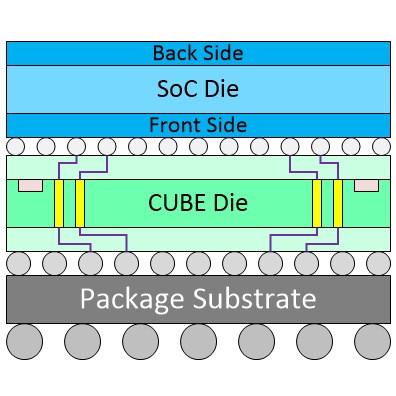
Winbond’s CUBE Memory Is Anything but Square

Do you remember those dim and distant days when the term AI (artificial intelligence) wasn’t on everybody’s lips? I’m aware that researchers and academics have been beavering away on AI since the Dartmouth Workshop in the summer of 1956, but for decades their labors rarely impinged on the public’s collective consciousness.

Admittedly, the topic of Expert Systems did raise its ugly head circa the 1990s, but these little scamps rarely managed to live up to the marketing … Read More → "Winbond’s CUBE Memory Is Anything but Square"

AMD develops Virtex UltraScale+ FPGA with low-latency Ethernet for its Alveo UL3524 fintech accelerator card

AMD has announced an FPGA-based accelerator card with ultra-low-latency Ethernet ports, specifically designed for high-frequency financial trading. Like all such cards, the Alveo UL3524 accelerator card pairs an FPGA with several high-speed, low-latency Ethernet ports, which terminate in four QSFP-DD cages. Each QSFP-DD cage is driven by eight GTF TX/RX transceiver pairs that terminate in the FPGA. The important specification for this card is the low Ethernet transceiver latency, which AMD claims is less than 3ns, which AMD … Read More → "AMD develops Virtex UltraScale+ FPGA with low-latency Ethernet for its Alveo UL3524 fintech accelerator card"

Microchip’s Newest 8-bit, 14/20-pin MCU Adopts I3C Bus for 2-Pin Interfaces to High-Speed Devices

Microchip has just announced the PIC18-Q20 family of 8-bit microcontrollers (MCUs) that feature larger program and data spaces, an I2C peripheral block and one or two I3C peripheral blocks, very low pin counts, and packages as small as 3×3 mm. These devices are available in 14- and 20-pin packages with 16 to 64 Kbytes of on-chip Flash memory for program storage, 1 to 4 Kbytes of on-chip SRAM for data storage, and 256 bytes of EEPROM located in the program-memory address space for non-volatile data storage, including network and security keys and calibration constants. Currently, there are six devices … Read More → "Microchip’s Newest 8-bit, 14/20-pin MCU Adopts I3C Bus for 2-Pin Interfaces to High-Speed Devices"

Are We Ready for the 2nm Process Node?

I’m a simple man. We could stop this column here and call it a day, but mayhap you were expecting more. Oh well if you insist. As you are doubtless aware, there’s a lot of buzz about the forthcoming 2nm process node, but what does this term actually mean in the real world? Ah, therein lies the rub, as the Bard might say.

The term “process node” (a.k.a. “process technology,” “technology node,” or just “node”) refers to a specific semiconductor manufacturing process. As part of this, we include a … Read More → "Are We Ready for the 2nm Process Node?"

featured blogs
Mar 20, 2026
From machines that see and think, to systems that act, and the humans that nudge them along....