feature article archive
Subscribe Now

DARPA Funds Space Lasers to Bring Non-Sectarian Internet Communications to Outer Space

Have you noticed that low-Earth orbit (LEO) is getting crowded? Several companies are developing globe-spanning satellite networks to provide Internet access to every square inch of the Earth’s surface. Elon Musk’s SpaceX and Starlink may be the most visible venture, but other entrants in this derby include Amazon’s Project Kuiper, SpaceLink, Viasat, and Telesat. On the one hand, it’s going to be very handy to have multiple companies competing to spread Internet-based communications everywhere. On the other hand, there’s an issue of compatibility that’s raising its ugly head. All of … Read More → "DARPA Funds Space Lasers to Bring Non-Sectarian Internet Communications to Outer Space"
O-M-Gosh, I’ve Been Zeked! (Part 3)

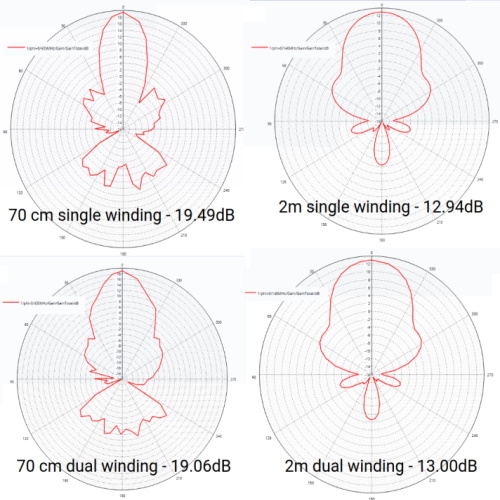
As you may recall from my previous “O-M-Gosh, I’ve Been Zeked!” columns, 11-year-old Zeke is on a mission to talk to the astronauts and cosmonauts orbiting the Earth on the International Space Station (ISS). He started by getting his ham radio license when he was only 8 years old, and now he’s working on getting his 10-foot helical antenna to track the space station. … Read More → "O-M-Gosh, I’ve Been Zeked! (Part 3)"

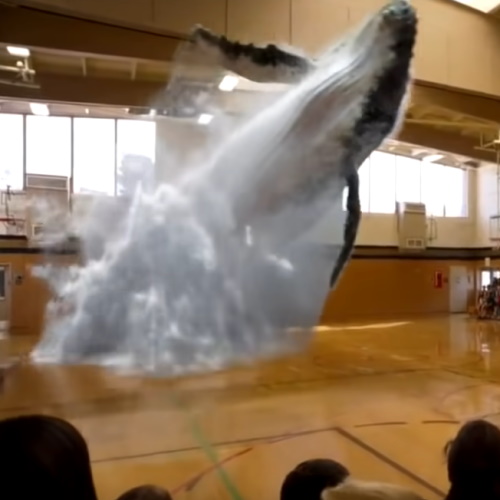
How Long Until We See Whales in Classrooms?

Do you remember all the hoopla about the company Magic Leap a few years ago? I’m trying to remind myself of the timeline. The company was founded in 2010 but was in stealth mode until around 2015. In 2016 they released a teaser video that showed what purported to be augmented reality (AR) in the form of a whale surprising school students by jumping into a gym. … Read More → "How Long Until We See Whales in Classrooms?"

Looming Crypto Crisis Rides In With Quantum Computing

It seems, increasingly, like writing technology articles is becoming nothing more than covering a long list of unfolding crises. The crisis du jour is the imminent breakdown of cryptographic security, thanks to the expected arrival of quantum computers. Today’s cryptography relies heavily on implementations of RSA public-key cryptography, which is now used pervasively for data encryption and decryption in networking and computing. RSA encryption – named after its inventors: Rivest, Shamir, and Adleman – relies on the difficulty of decrypting the encoded data without a key, which requires some bodacious math to factor large numbers if you … Read More → "Looming Crypto Crisis Rides In With Quantum Computing"

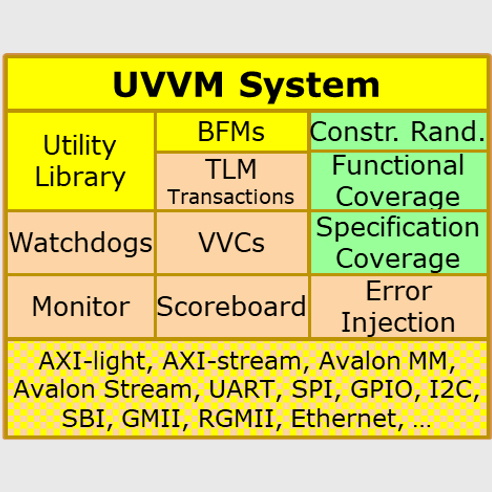
Meet UVVM: The World’s #1 VHDL Verification Methodology

I’m happy (albeit puzzled) to tell you that things seem to be getting better with respect to verifying FPGA, ASIC, and system-on-chip (SoC) designs. The reason I say this is that the last time I turned my attention to this arena, people were saying that the design and verification phases of a complex device consumed 30% and 70% of the total development time, respectively. By comparison, someone recently informed me that these numbers are now more like 50% and 50%, which means either we’ve become better at doing verification or worse at doing design.

As … Read More → "Meet UVVM: The World’s #1 VHDL Verification Methodology"

FPGA Saves the World (Sort of), Part 2

On September 26 of this year, the DART (Double Asteroid Redirection Test) spacecraft slammed into the moonlet/asteroid Dimorphos and vaporized itself into an expanding plume of atomized debris. Fifteen days prior, DART had released LICIAcube – the Light Italian CubeSat for Imaging Asteroids – which was hitchhiking along for the ride. However, LICIAcube wasn’t a joyrider. It had an important mission: to capture images of DART’s impact with Dimorphos and subsequent vaporization from a safe distance – about 50 kilometers from Dimorphos – and then to image the other, unseen side of Dimorphos after the impact. DART would never … Read More → "FPGA Saves the World (Sort of), Part 2"

FPGA Saves the World (Sort of)

On Sept. 26, 2022, at 7:14 pm EDT, NASA’s DART (Double Asteroid Redirection Test) spacecraft slammed into an asteroid moonlet called Dimorphos, which orbits around a larger asteroid named Didymos. Dimorphos, roughly 163 meters in diameter, was not threatening anything. It was minding its own business, circling Didymos, when a spacecraft from Earth, roughly the size of a vending machine, rudely crashed into the mini moon. The DART mission, launched on November 24, 2021, is the world’s first test of a potential planetary defense mechanism against asteroids that might potentially hit the Earth and cause tremendous damage with massive loss … Read More → "FPGA Saves the World (Sort of)"

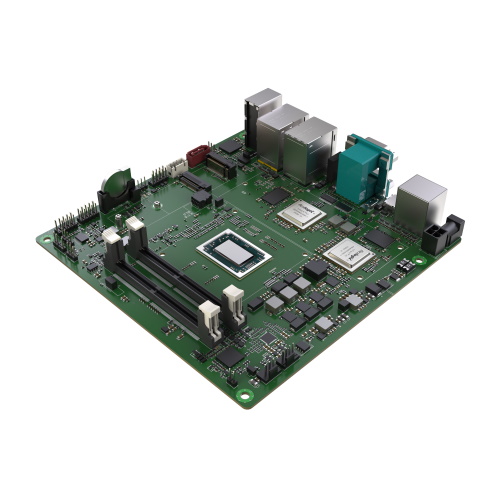
Say “Howdy” to the Hawk AI Integrated Mini-ITX System

When a lot of people hear the name Flex Logix, their knee-jerk reaction is to think eFPGA (“Embedded FPGA”). While it is certainly true that the guys and gals at Flex Logix have a commanding presence in eFPGA space (where no one can hear you scream), they are also making waves in artificial intelligence (AI) inferencing space (where AI systems will hear you scream).

As an aside, on the off chance you didn’t see the movie, “In space no one can hear you scream” is the iconic tagline of … Read More → "Say “Howdy” to the Hawk AI Integrated Mini-ITX System"

Cars and Robots with Smart Skins That Can Feel

I’ve made no secret of the fact that I love science fiction. Thinking about it, you probably wish I’d stop waffling on about this topic. If so, I’m afraid that you’re out of luck (sorry). Ever since I first read I Robot and The Rest of the Robots by Isaac Asimov when I was a young lad, I totally bought into the concept that we would one day create humanoid-shaped and other intelligent robots. … Read More → "Cars and Robots with Smart Skins That Can Feel"

Intel’s Gamble on oneAPI and DPC++ for Parallel Processing and Heterogeneous Computing: An Interview with Intel’s James Reinders

Intel is placing many big bets on semiconductor process improvements, building new fabs and manufacturing plants around the world, new packaging technologies, and even software. One of those bets, or perhaps a group of bets, is oneAPI and Data Parallel C++ (DPC++), which are an open, cross-architecture programming model that frees developers to use a single code base across multiple architectures and a parallel-programming variant of C/C++ based on Khronos SYCL. These bets are designed to make it easier for software developers to create relatively portable code for systems based on heterogeneous computing architectures.</ … Read More → "Intel’s Gamble on oneAPI and DPC++ for Parallel Processing and Heterogeneous Computing: An Interview with Intel’s James Reinders"

featured blogs
Mar 20, 2026
From machines that see and think, to systems that act, and the humans that nudge them along....