feature article archive
Subscribe Now

When MIPS Used to Mean Something

“640KB ought to be enough for anybody.” – Bill Gates [disputed]

Back when the MIPS computer architecture was first created, MIPS meant one of three things. It was either “millions of instructions per second,” or, in the case of the CPU itself, “microprocessor without interlocked pipeline stages.” Cynical engineers also called it “meaningless indicator of performance for salesmen.”

These days, a processor that can process only a million instructions per second seems unutterably quaint, like a steam-powered sawmill. One MIPS is nothing. We want hundreds of MIPS – possibly thousands of MIPS (GOPS).</ … Read More → "When MIPS Used to Mean Something"

Achronix Goes Chipless

Since 2013, Achronix has been cruising along, quietly doing a decent business with their Speedster FPGA family. Their particular value proposition resonates well for certain networking and acceleration applications, and they’ve mined a good business by strategically poking at gaps in the Xilinx and Altera product offerings in certain markets. More recently, their Accelerator-6D PCIe board – bringing FPGA-based compute acceleration to existing server installations – has gotten good reviews. 

At the same time, though, they’ve apparently also been stealthily working a novel angle – licensing their FPGA IP for teams doing complex custom … Read More → "Achronix Goes Chipless"

A Boosted MOS Transistor

You may remember that, early this year, we took a look at a 1-transistor (1T) SRAM bit cell. (Yes, new memory stuff seems all the rage lately – and we’re probably not done yet.) Well, there’s another story evolving out of that 1T cell, only it’s not related to memory. It’s related to one of the most fundamental devices in our toolkits: the transistor itself. … Read More → "A Boosted MOS Transistor"

What World Maker Faire Shows Us About the Future of Engineering

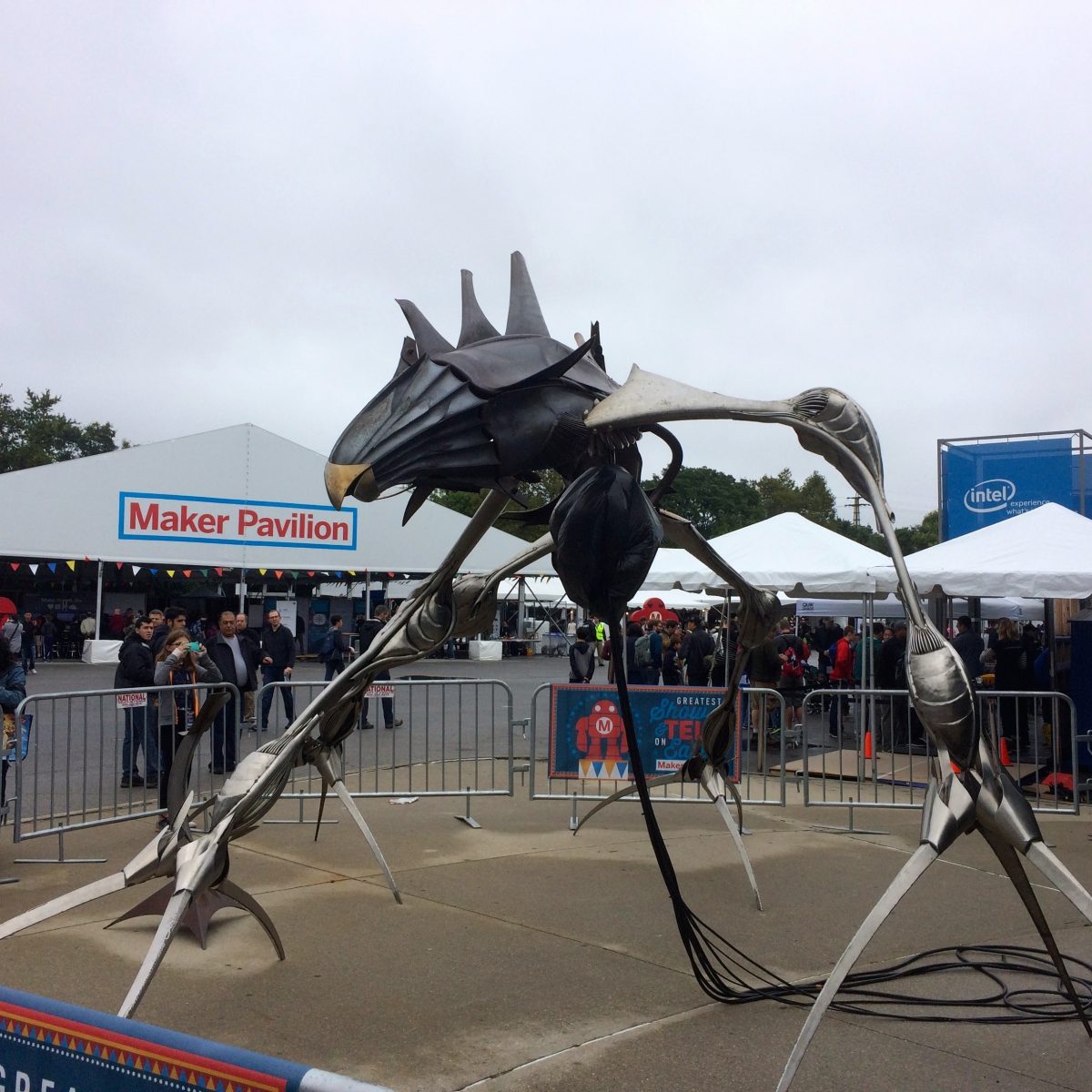
World Maker Faire is an event defined by its energy. In past years, EE Journal has tried to capture this mix of inspiration, enthusiasm, and community in our coverage of the Faire in previous years. But perhaps the best way to convey a sense of the event is to present a collection of quotes from people talking to our EE Journal team this year at the Faire, or that we … Read More → "What World Maker Faire Shows Us About the Future of Engineering"

Signals for Noise

“Ten people who speak make more noise than ten thousand who are silent.” – Napoleon Bonaparte

Noise is big business these days. And, this week, we look at three brand new chips that all make noise, more or less deliberately.

First up, there’s Cirrus Logic’s new CS47L90, the first of what I suspect will be a series of high-powered audio chips. Cirrus calls it a “smart audio codec,” but that undersells the device’s capabilities. This is a 7-processor beast designed to wrestle audio streams to the ground and make them … Read More → "Signals for Noise"

The FPGA Tool Problem

Wouldn’t it be great if there were more options in FPGA tools? For decades now, the FPGA community has decried the lack of FPGA design tool options. You’d think that a technology that has been evolving and maturing for over thirty years would have long ago reached the point where there were a wide variety of competitive programming options to choose from. However, we are still basically at the point where there is one and only one option for doing your FPGA design – the tool suite sold and distributed by the FPGA company itself. 

< … Read More → "The FPGA Tool Problem"

Organically-Shaped Antennas

Imagine if there were one formula. All of existence, explained by one formula. All of the formulas we use today? Simply special cases of that one formula. Like the elusive unified field theory that would embrace all known forces, this would be a Formula for Everything. And you’d call it the Superformula.

Well, it turns out that there is a thing called The Superformula, and credit goes to one Johan Gielis. It’s relatively recent (by scientific standards, not by technology standards): 2003. But, the name notwithstanding, this isn’t a Formula That Describes Everything. It is … Read More → "Organically-Shaped Antennas"

Move Over, Connected Toaster; Here Comes the Connected Climbing Wall

Yannick Chammings, CEO of French company Witekio, was explaining to me why they were changing the company name (previously they were called Adeneo Embedded), and why this was intended to show how they were changing the way in which they worked with their customers. As a part of this, he started talking about a connected climbing wall.  Now climbing walls, while becoming increasingly popular, I think of as essentially dumb. You have an imitation rock face, built from a range of materials, with hand- and foot-holds screwed into a matrix of sockets. The holds can be colour-coded to indicate … Read More → "Move Over, Connected Toaster; Here Comes the Connected Climbing Wall"

Programmability for the People

It’s always fun to fantasize about Ferraris and FinFETs. After all, what true engineer doesn’t get a little tingly talking about terabits of bandwidth, single-digit nanometers, and gazillions of LUTs. But, in practical terms, the vast majority of us don’t have an actual application need for the biggest, fastest FPGAs and SoCs on the market. And, while it’s fun to watch and speculate about which company can cram the most transistors onto an integrated circuit, the reality is that, for most of us, our actual requirements are much more modest.

Qualcomm Discovers Its Long Tail

“Headlines, in a way, are what mislead you because bad news is a headline, and gradual improvement is not.” – Bill Gates

Well, that didn’t take long.

In yet another example of the “what gets measured gets done” syndrome, some TV manufacturers now stand accused of cheating on their energy-consumption testing. According to the environmental monitors at the Natural Resources Defense Council, several big-screen TVs are Read More → "Qualcomm Discovers Its Long Tail"

featured blogs
Apr 2, 2026
Build, code, and explore with your own AI-powered Mars rover kit, inspired by NASA's Perseverance mission....