feature article archive
Subscribe Now

Intel Announces World’s Fastest FPGAs with in-package HBM: The Intel Agilex M-Series FPGAs

Intel has just introduced the Agilex M-Series FPGAs with support for PCIe Gen5, Optane persistent memory, CXL, and high-speed Ethernet. Some of the FPGAs in the Agilex M-Series also incorporate integrated High Bandwidth Memory (HBM) DRAM stacks. FPGAs with integrated HBM DRAM stacks are not new. Both Intel and AMD-Xilinx have offered such devices for a few years. Xilinx announced its first FPGAs with integrated HBM, the Virtex UltraScale+ HBM FPGAs, in late 2016, although parts didn’t appear until early 2018. Intel’s first-generation FPGA family with integrated HBM2 DRAM stacks were the Intel Stratix 10 MX FPGAs, … Read More → "Intel Announces World’s Fastest FPGAs with in-package HBM: The Intel Agilex M-Series FPGAs"

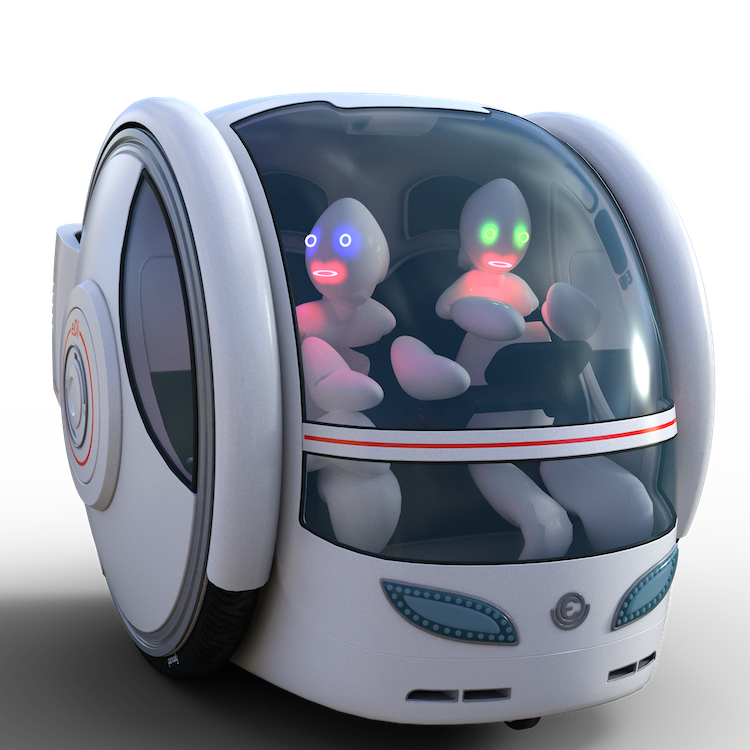
Is This the Future of Embedded Systems and IoT Things?

I think I’ve just seen the future of embedded systems and the “things” that form the Internet of Things (IoT). From what I can tell, it’s going to be a virtualized future that contains a cornucopia of containers. If only I knew more about virtualization in general, and containers in particular, I could rule the world.

Just speaking of the future caused the Days of Future Passed album, which was released by The Moody Blues in 1967, to pop … Read More → "Is This the Future of Embedded Systems and IoT Things?"

Getting Ever Closer to Fully Autonomous Vehicles

When I was but a young whippersnapper, the idea of self-driving vehicles was the stuff of science fiction. Even though many Poohsticks have passed under the bridge since those far off days of yore, and even though we still don’t have fully autonomous vehicles (AVs), I’m delighted to report that we are slowly getting there.

I know many people who hold no truck (no pun intended) with AVs. Some worry that they will be more hazardous than human-controlled vehicles. To these naysayers I would respond, “Have you driven … Read More → "Getting Ever Closer to Fully Autonomous Vehicles"

Happy 50th Birthday to the 8-bit Intel 8008 Microprocessor

Early microprocessors straddled two major computing epochs. During the first epoch, stretching from the late 1960s through the 1970s, computer system engineers designed and implemented minicomputer processor architectures and processor boards using TTL parts, bipolar PROMs, stone knives, and bearskins. Each minicomputer maker – including Digital Equipment Corp (DEC), Data General (DG), Prime, Computer Automation, IBM, Burroughs, HP, Four-Phase, NCR, and Univac – had their own, proprietary minicomputer architectures, ISAs, and dedicated peripherals. It was the wild, wild West. During the second epoch, which partially overlapped the first epoch, some computer manufacturers and some semiconductor vendors started designing … Read More → "Happy 50th Birthday to the 8-bit Intel 8008 Microprocessor"

Brain Chips are Here!

I remember the heady thrill of the early 1980s when the unwashed masses (in the form of myself and my friends) first started to hear people talking about “expert systems.” These little rascals (the systems, not the people) were an early form of artificial intelligence (AI) that employed a knowledge base of facts and rules and an inference engine that could use the knowledge base to deduce new information.

It’s not unfair to say that expert systems were pretty darned clever for their time. Unfortunately, their capabilities were over-hyped, … Read More → "Brain Chips are Here!"

Happy Birthday to Gordon Moore

Gordon Moore celebrated his 93rd birthday at the beginning of this year (January 3). Moore and seven co-conspirators including Robert Noyce, collectively dubbed the “Traitorous 8,” left Shockley Semiconductor Laboratory en masse and founded Fairchild Semiconductor in 1957. In 1965, as Fairchild Semiconductor’s R&D Labs Director, Gordon Moore published a very short article titled “Cramming More Components onto Integrated Circuits< … Read More → "Happy Birthday to Gordon Moore"

Microchip tries to lure Xilinx Spartan-6 users with PolarFire, SmartFusion2, and IGLOO2

Last week, I wrote an article about Adam Taylor’s White Paper titled “Migrating Spartan 6 Design to 7 Series & Beyond.” In that White Paper, Taylor discusses many considerations for migrating from AMD-Xilinx Spartan-6 FPGAs to Spartan-7 FPGAs. The question arises because Xilinx introduced the Spartan-6 FPGA family in 2009, more than a decade ago, and because the 45nm process technology used to make Spartan-6 devices is getting rather long in the tooth. The company-recommended … Read More → "Microchip tries to lure Xilinx Spartan-6 users with PolarFire, SmartFusion2, and IGLOO2"

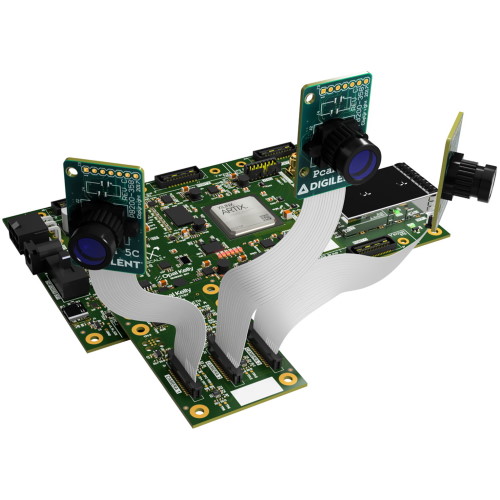
Artix UltraScale+ (Xilinx) + XEM8320 (Opal Kelly) = SYZYGY’s Time to Shine

I have a tale to tell with so many fabulous facets that I’m hard pushed to know where to start. We could come at this from so many different directions. I’ll tell you what — let’s just bite the bullet, as it were, and plunge headfirst into the fray with gusto and abandon. So, pull up your socks and hold hard onto your hat. Are you ready? Here we go…

Let’s start with Read More → "Artix UltraScale+ (Xilinx) + XEM8320 (Opal Kelly) = SYZYGY’s Time to Shine"

Something’s Coming but I Can’t Say What!

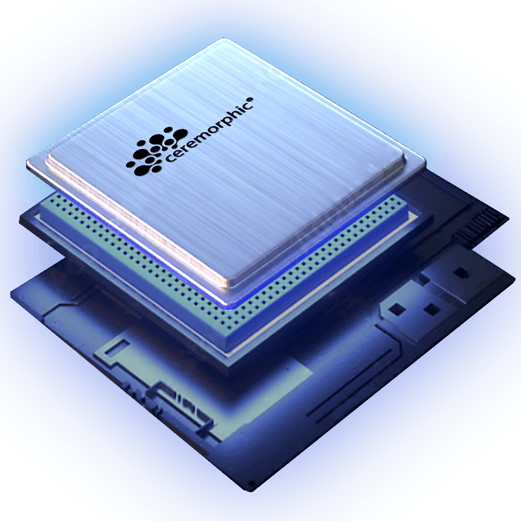
I just received an unusual briefing, and now I’m sitting here at the start of this column looking at a blank page thinking to myself, “So, how do I go about explaining this one?” What we’re talking about here is a next-generation processing chip that’s based on a new processing architecture. Known as a hierarchical learning processor (HLP), this technology is intended to be a game-changer for tasks like artificial intelligence (AI) training, high-performance computing (HPC), and metaverse processing (don’t ask, I’ll tell you later).

Read More → "Something’s Coming but I Can’t Say What!"

Spartan-6 vs Spartan-7: Should I Stay or Should I Go?

Xilinx announced the Spartan-6 FPGA family in 2009, based on a 45 nm IC process technology. Over time, the Spartan-6 LX family grew to encompass FPGAs with 3.84K to 147K logic cells, as many as 576 I/O pins, 180 DSP slices, and 268 18-Kbit Block RAMs. Spartan-6 LXT FPGAs provide the same range of logic resources as the Spartan-6 LX family members, while providing as many as eight GTP transceivers, each capable of operating at 3.125 Gbps, and one PCI Express end point, capable of operating at 2.5 Gbps. (Note: That’s the PCIe 1.0 data rate per lane.)

Read More → "Spartan-6 vs Spartan-7: Should I Stay or Should I Go?"

featured blogs
Mar 20, 2026
From machines that see and think, to systems that act, and the humans that nudge them along....