feature article archive
Subscribe Now

Intel’s Agilex 7 FPGAs Take Barcelona by Storm

As part of giving courses on digital logic simulation, along with presentations at technical conferences and guest lectures at universities, I’ve been fortunate enough to have at least sampled a tempting taster of many of the countries in Scandinavia and Western Europe, including Denmark, Norway, Sweden, France, Greece, Germany, Italy, the Netherlands, and Switzerland.

Sad to relate, one of the countries on my “bucket list” that I’ve yet to see is Spain, and one of the cities in Spain I’ve long wished to visit is Barcelona. Several of my English … Read More → "Intel’s Agilex 7 FPGAs Take Barcelona by Storm"

Is the Future of AI Sparse?

I think we’re all familiar with the old riddle joke that starts with the question, “Why did the chicken cross the road?” and ends with the answer, “To get to the other side!” This is one of the things we seem to learn by some form of sociological osmosis without ever being able to recall where we first heard it.

According to the Wikipedia, this is an example of something called “anti-humor” in which the curious setup of the joke leads the listener to expect a traditional punchline, but they are instead … Read More → "Is the Future of AI Sparse?"

Winston Kock: Right Place, Right Time, Right Idea

During research for my recent 6-part article series on the early transistor makers, I tried to find information on the companies that attended the 1952 Bell Labs Transistor Symposium, yet clearly never made transistors. One of those companies was listed as “The Baldwin Company.” Searching the Internet, the closest match I could find for that corporate name was the Baldwin Piano Company. I wondered, what thread could possibly tie a piano company to Bell Labs and point-contact transistors?

A little more research revealed the thread. It was a name: Dr. Winston … Read More → "Winston Kock: Right Place, Right Time, Right Idea"

100+ AI-Designed SoCs and Counting!

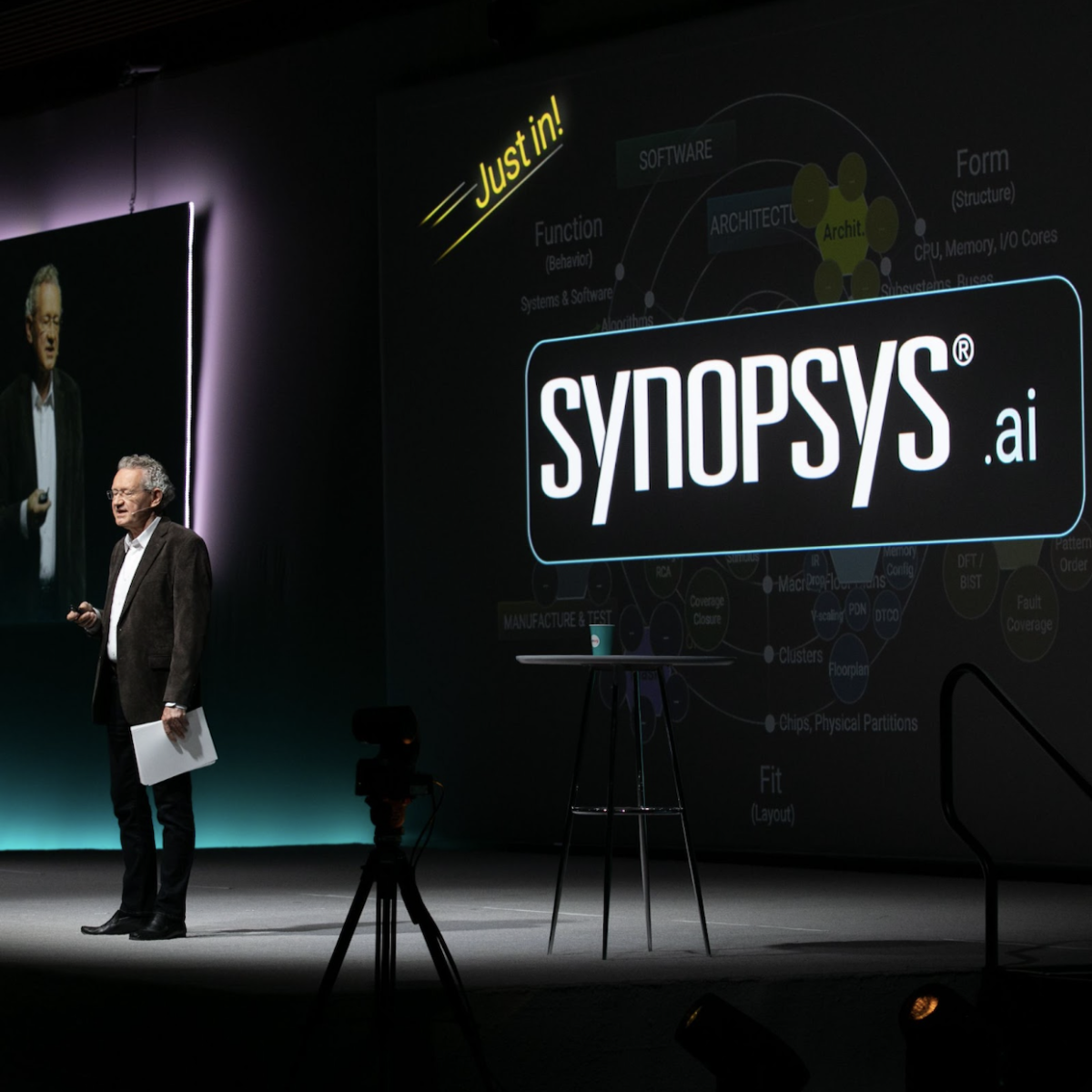
Way back in the mists of time we used to call 2020, the guys and gals at Synopsys launched DSO.ai (Design Space Optimization AI), which they described as being “The industry’s first autonomous artificial intelligence (AI) application for chip design.”

As they said at that time, “DSO.ai searches for optimization targets in very large solution spaces of chip design, utilizing reinforcement learning to enhance power, performance, and area. By massively scaling exploration of design workflow options while automating less consequential decisions, the award-winning DSO.ai drives higher engineering productivity while swiftly … Read More → "100+ AI-Designed SoCs and Counting!"

Tick Tock: The Quantum Boogeyman is Coming for Your Most Sensitive Data

Here’s a little thought experiment for you. It starts with a question:

When do you think that practical quantum computers will be available?

Please feel free to leave your answer as a comment below. Due to the nature of this publishing medium and the way it works, I won’t get your answer for a few weeks, but I can assure you that your answer will not alter the results of this thought experiment.

Because I can’ … Read More → "Tick Tock: The Quantum Boogeyman is Coming for Your Most Sensitive Data"

Mind-Boggling Neuromorphic Brain Chips (Part 2)

In my previous column, we discussed how the year 2030 seems set to be an exciting time to be in artificial intelligence (AI) and machine learning (ML) space (where no one can hear you scream). For example, in addition to the industrial IoT (IIoT) we also have the artificial intelligence of things (AIoT).

“What’s the AIoT when it’s at home?” I hear you cry. Well, according to the IoT Agenda, “The AIoT is the combination of AI technologies with … Read More → "Mind-Boggling Neuromorphic Brain Chips (Part 2)"

Mind-Boggling Neuromorphic Brain Chips (Part 1)

I can’t help myself. I keep thinking about the 1961 musical Stop the World—I Want to Get Off. After opening in Manchester, England, the show transferred to the West End, London, where it ran for 485 performances.

It’s not that the plot of this extravaganza has anything to do with what we are talking about here. It’s just that the sentiment embodied by the show’s title reflects the way I’m currently feeling about artificial intelligence (AI) and machine learning (ML).

On the one … Read More → "Mind-Boggling Neuromorphic Brain Chips (Part 1)"

Siemens Adds AI and Big-Data Management to Its Questa Verification EDA tools

It’s no secret that ASIC and ASSP designs are getting more complex. First, there’s that whole thing about Moore’s Law allowing design teams to put more transistors, gates, memory cells, transceivers, processors, and acceleration engines on a chip. And, if that weren’t enough, there’s the relatively new quest to stuff an increasing number of chiplets into a package, tying them all together with 2.5D or 3D packaging techniques. The result is a geometric or exponential complexity increase for logic, power distribution, and thermal dissipation.

Less … Read More → "Siemens Adds AI and Big-Data Management to Its Questa Verification EDA tools"

XMOS: Using RISC-V to Define SoCs in Software

My university degree was what they call a co-op course in the USA. Standing for “cooperative education,” this refers to a program that balances classroom theory with periods of practical, hands-on experience. There were two types of such courses in the UK. One type was called a “thin sandwich” because it involved short alternating 6-week periods in and out of college. The other type, which I was on, was called a “thick sandwich” because it involved longer periods. As I recall, we were in college for a year, out in industry for six months, back in … Read More → "XMOS: Using RISC-V to Define SoCs in Software"

The Transistor at 75: The First Makers, Part 6

The first five articles in this series discussed early licensees of the Bell Telephone Labs (BTL) transistor patents in the US and Europe. However, one more geographic region was actively involved in transistor development during the early 1950s: Japan. This final article in the series covers the story of one Japanese company’s efforts to license, make, and use transistors based on the BTL transistor patents.

Japan’s surrender on August 15, 1945 and the subsequent signing of surrender documents on September 2 marked the end of World War II. That same month, … Read More → "The Transistor at 75: The First Makers, Part 6"

featured blogs
Jan 29, 2026
Most of the materials you read and see about gyroscopic precession explain WHAT happens, not WHY it happens....