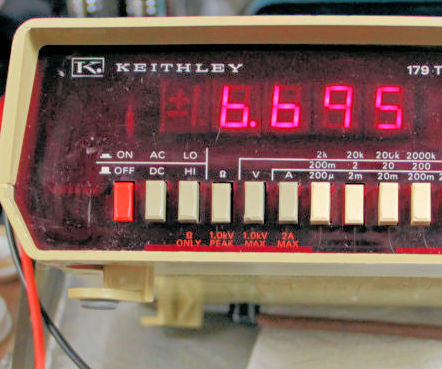
Shortly after repairing my Keithley 179 digital multimeter (see “The Case of One Dead Digital Multimeter”), the meter failed yet again. After turning it on, all the LED display would do was cycle on and off at a slow 1Hz rate while displaying random readings. A suspiciously loud buzz emanated from the DMM, sounding on and off in sync with the flashing display. Initially, I suspected that the mechanical pushbutton gang switch had oxidized again, because I’d seen this symptom before when I first repaired the DMM. Because I now had a working Keithley 197 DMM (see “A Tale of Two Multimeters – Part 1: Fixing rubber buttons on the Keithley 197 DMM”), I put the Model 179 up on a shelf. A year later, I decided to take the Model 179 down from the shelf so that I could repair it. I pulled up the manual, printed the schematic on six sheets of paper, and then carefully taped the sheets together in preparation for the repair effort.
The Keithley Model 179 DMM is based on the Intersil ICL7103 4.5-digit ADC chip. (Intersil is gone, so finding one of these parts could have been problematic unless you’re brave enough to order one from an overseas seller on eBay.) Because pushing the gang switches on the DMM’s front panel had no effect on the symptoms, I started with the most fundamental electronics troubleshooting step: always check the supply voltages first.
The Model 179 DMM has a simple power supply circuit. A line-powered transformer has a secondary winding for +5V and a center-tapped secondary winding for the ±15V power rails. Three-terminal linear regulators provide the voltage regulation. The ±15V rails looked fine, but the power supply’s +5V output read 3V. That’s not good. The input voltage to the power supply’s 7805 5V regulator read 4V. That’s not good either. I scoped the input to the 7805 and saw raw ac voltage. Clearly, the 2200 μF filter capacitor had failed.
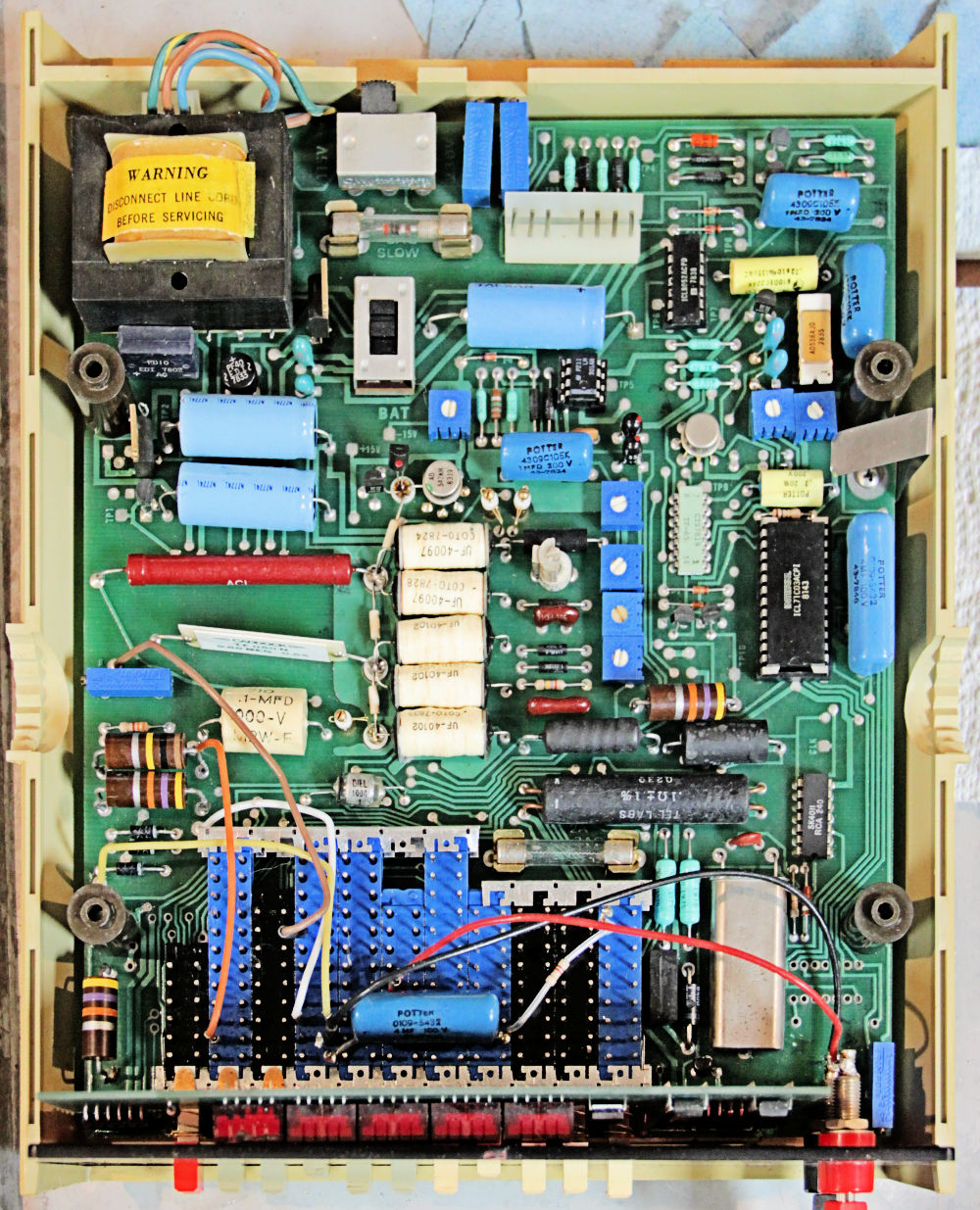
The failed 2200 μF axial filter capacitor (light blue) appears in the upper center of this photo just below the white Molex connector and to the right of the slide switch. I replaced it with a radial capacitor and insulated the capacitor’s legs to prevent shorts to the pc board. I’m also keeping an eye on the two 470 μF axial filter capacitors just below the transformer. The previously repaired gang switch appears at the bottom of the photo. Image credit: Steve Leibson
I have an inexpensive universal component tester that I purchased from eBay and it does a remarkable job considering that it cost me less than $20. I hooked up my tester to the 2200 μF filter capacitor, in circuit, and it read 29 nF, low by a factor of 100,000. Given the huge discrepancy between the printed and measured values for capacitance, I checked the capacitor again using the capacitance range of a DMM. It measured 27 nF. I remained unconvinced and ordered a tweezer-style Zoyi ZT-MD1 LCR tester from eBay for about $30. It read 26 nF. Finally, I was convinced. I guess that electrolytic capacitor really had failed.
A quick order to Amazon produced a box of seven radial 2200 μF capacitors, supposedly made by Rubycon, for $6.99. I prefer to buy from the regular electronics distributors such as DigiKey and Mouser whenever possible, but Amazon’s 1-click ordering, two-day delivery, and prepaid shipping via Amazon Prime have made Amazon my default. But with Amazon’s reputation for counterfeit electronic parts, I don’t think you should ever use electronic components from Amazon for production. I suspect that the capacitors I got from Amazon might not be authentic Rubycons. The capacitors are branded Rubycon, but the box says, “Made in China.” The component tester verified their capacitance, and all but one of the seven capacitors had very close capacitance readings, which suggests some degree of quality control, so I soldered one of these 2200 μF Amazon “Rubycon” filter capacitors into the Keithley 179 and it came back to life.
That might have been the end of the story, but I was now suspicious of the filter capacitors on the ±15V supplies. They were 470 μF each and equally as old as the failed capacitor. Another Amazon purchase and I was ready to replace those capacitors too. I would have preferred to replace the Keithley’s axial filter capacitors with new axials, but that’s not a choice on Amazon. I put the new 470 μF capacitors in stock, in case the Keithley failed again.
A month or so later, I was in Houston and decided to visit the local surplus electronics store, as I sometimes do. The place that I chose to visit appears to be Houston’s premier spot for surplus and used electronics: the Electronic Parts Outlet. I’d not visited this store before, but it was only 20 minutes from my hotel, just off of Houston’s Westpark Tollway, so I jumped in the car and went. I was looking for 470 μF axial capacitors, in addition to just wanting to see the place.
When I arrived, I found a medium-sized storefront in a small strip mall. The outside belies the inside. The outside of the Electronics Parts Outlet may be modest, but the inside is Aladdin’s Cave of Wonders. This store contains samples of nearly every component and every small electronic product made since World War II.

The Electronic Parts Outlet, aka Aladdin’s Cave of Wonders, in Houston, Texas. Image credit: Steve Leibson
I headed to the capacitor aisle and saw a nicely organized array of wall-mounted bins on one side and a jumbled array of pegboard items, overflowing baskets, and piles of stuff on the other. The 470 μF capacitor bin was empty, so I turned to the hanging items on the pegboard side. At that moment, one of the people working in the store came up to me and asked if he could help me find something. I told him what I was looking for and he pointed to a basket full of carded capacitors. He said, “Somewhere in there, I imagine.” Then he went off to answer a phone call. I combed through the basket and found two carded Sprague Atom capacitors rated 500 μF. You know they’re old when the capacitance values aren’t standard, but 500 μF was close enough.
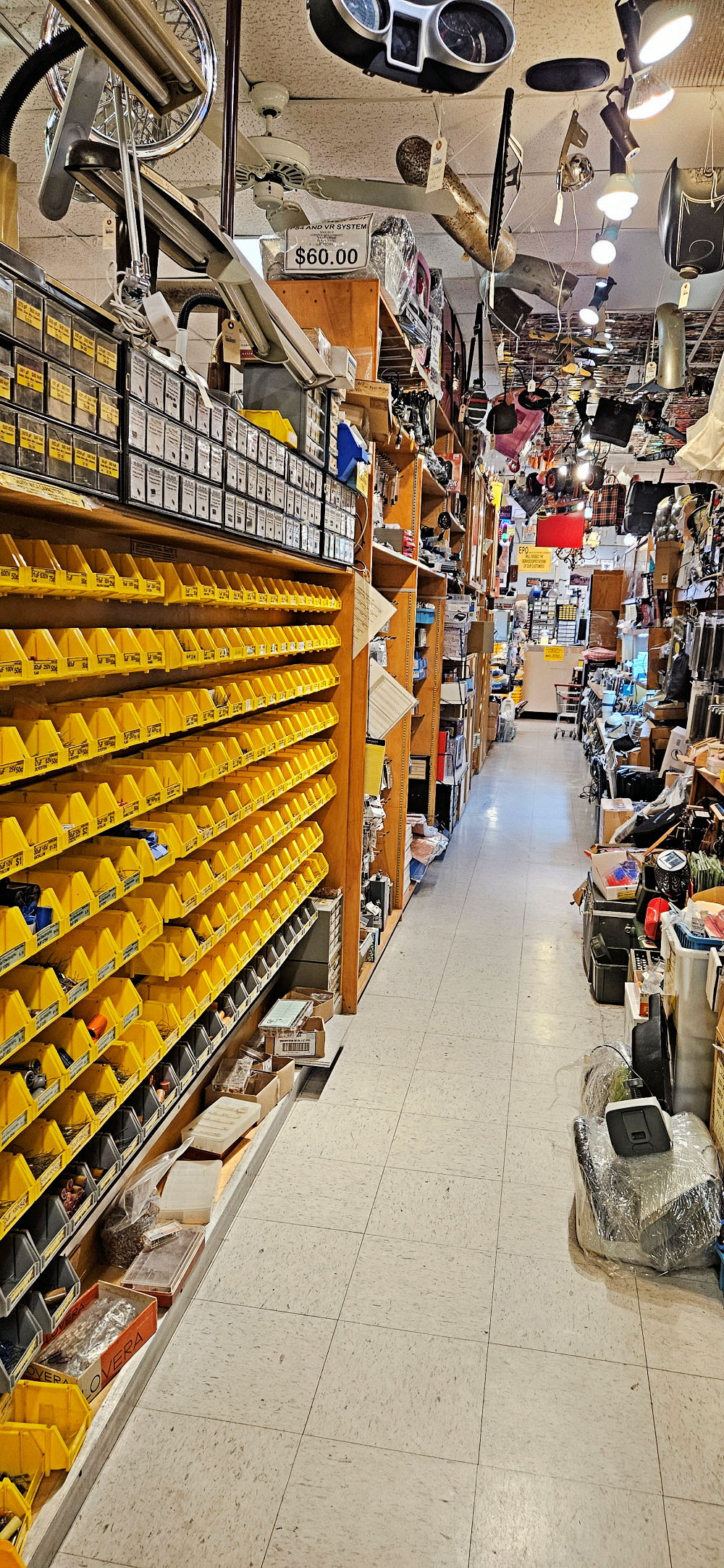
The capacitor aisle at the Electronic Parts Outlet in Houston. Take a good look at the ceiling inventory as well. This photo was taken mid-store, and there was an equal amount of stuff behind me when I shot this photo. Image credit: Steve Leibson
The salesperson soon returned, and I discovered that he was Chris Macha, the store’s owner. He proceeded to give me the executive tour of his store. The tour lasted an hour, but I suspect Chris would have talked for as long as I liked.
Electronic Parts Outlet isn’t merely a store full of parts and wonders, it’s been building a thriving electronics community since 1985. Community building includes monthly lectures and more frequent summer classes on a range of topics from soldering and basic electronics to Arduino programming and RF. Old-timers (like me) regularly give lectures.
Some of the store’s regular customers take home old radios and televisions, restore them, and then return them. Here’s a couple of shelves full of their handiwork:
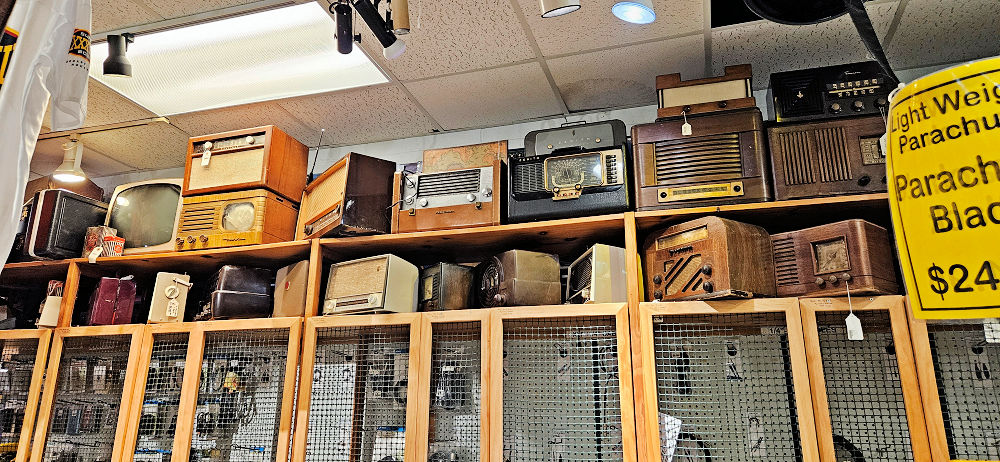
A shelf full of restored radios and TVs at the Electronic Parts Outlet. Image credit: Steve Leibson
You’ll also find a collection of old VCRs and 8-track tape players. If electronics aren’t your only interest, the store has bicycle parts, cameras, and musical instruments as well. The store’s organization most resembles that of an antiques mall.
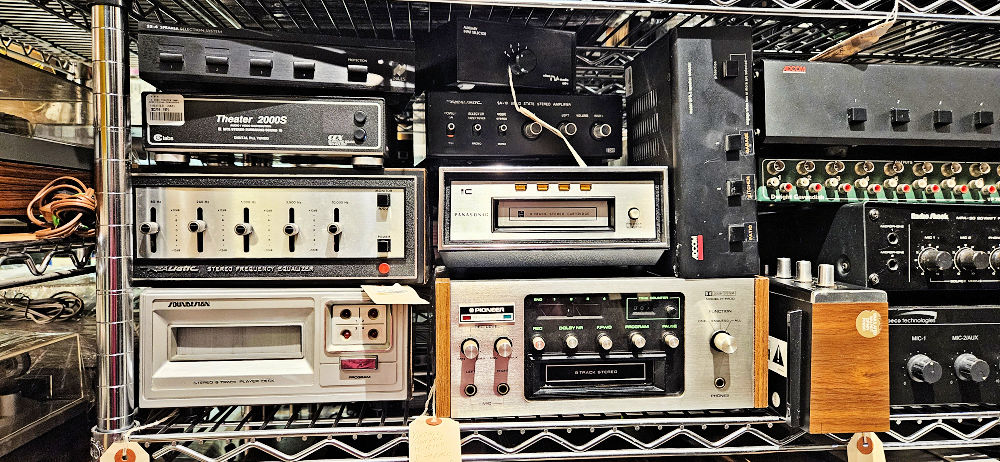
8-track tape players at Electronic Parts Outlet. Image credit: Steve Leibson
If you’re into old test equipment, they’ve got you covered. I saw three rare HP frequency counters with Nixie-tube displays. I’m sure I’ve owned or used several of the HP, Tektronix, and Heathkit instruments shown in the photo below.
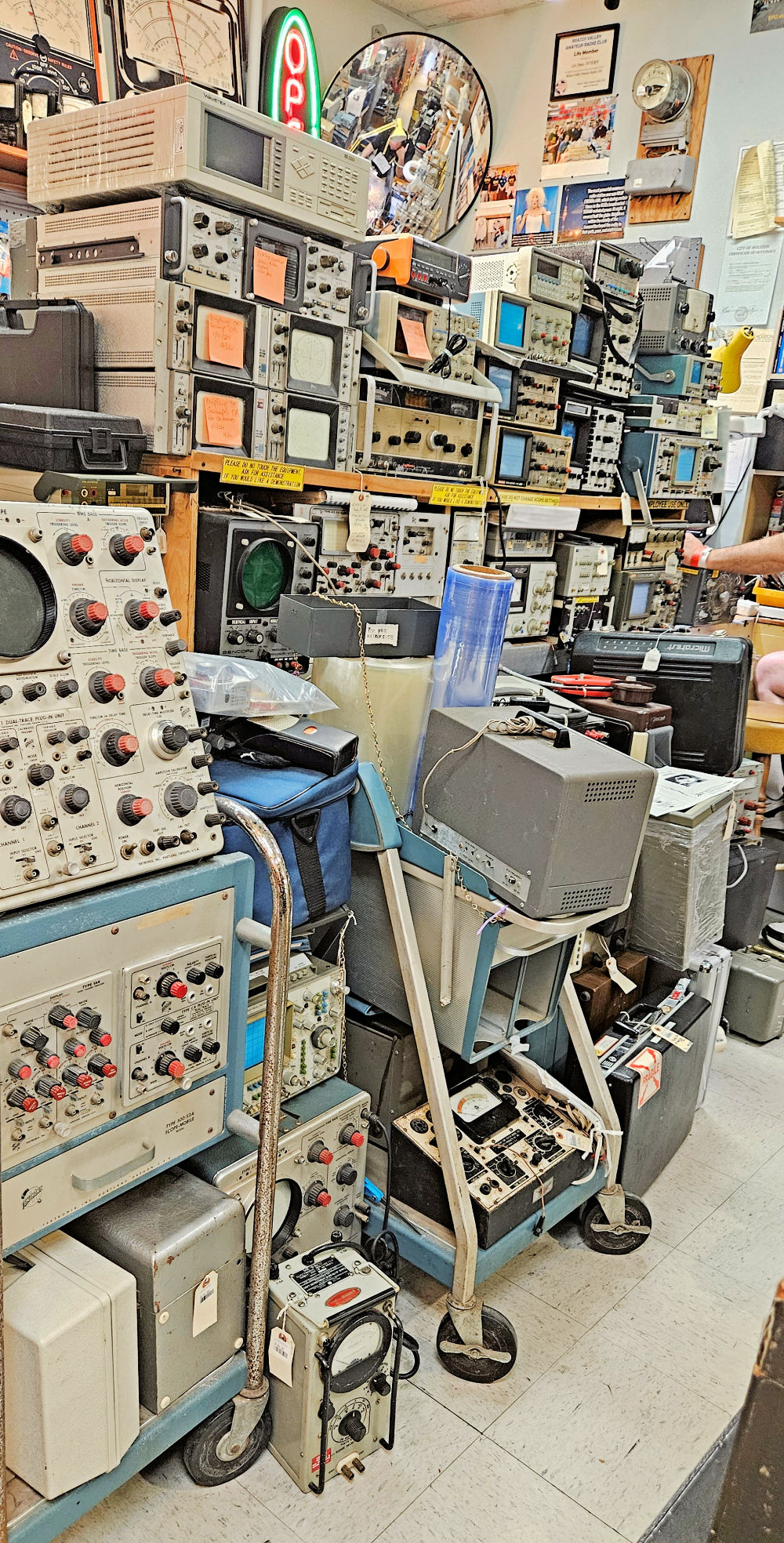
Electronics Parts Outlet has a large selection of old test equipment. Image credit: Steve Leibson
At the end of the tour, Chris took me to the front of the store to show me a very old teleprinter that they were trying to get it working. I said I thought it was an old Baudot machine and he said it used five bits per character and only printed upper-case letters. That’s a Baudot teleprinter. Way back in the 1970s while working at HP, I designed the 98036A serial interface card for the 9825A desktop computer. It incorporated a current-loop interface specifically for these old teleprinters. I asked Chris for a piece of paper and drew a simple, 3-component UART-to-current loop driver that would work with any of the microcontroller boards sold at the Electronic Parts Outlet. He’ll need a UART that can operate at 45 or 50 bits per second, but I’m sure someone there will figure it out, even if they need to bit-bang the UART using software.
Finally, I made my way to the front counter to purchase my two 500 μF Sprague capacitors and a USB mini cable for my Garmin GPS unit. The bill came to $6.44, including tax. Well worth the price of admission to this Cave of Wonders.
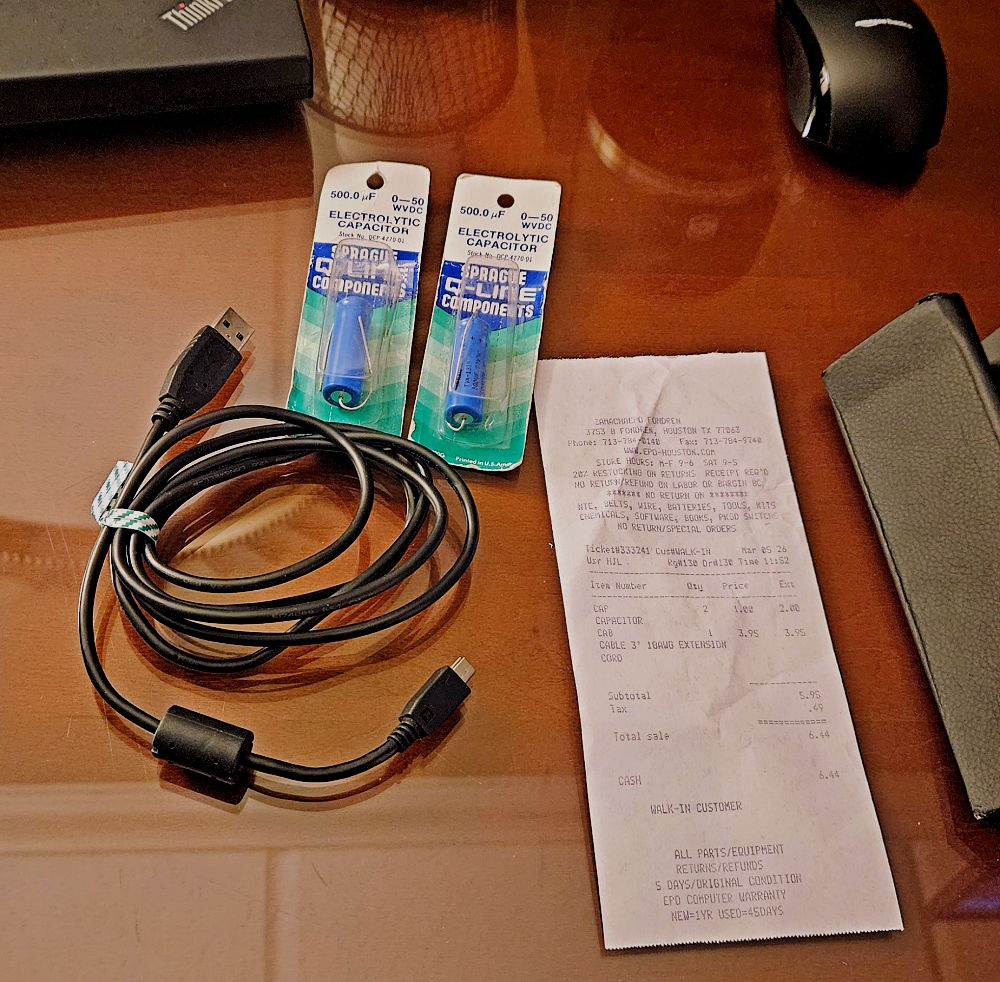
My final purchase from the Electronic Parts Outlet: two Sprague 500 μF capacitors and a USB cable for my Garmin GPS unit. Total bill: $6.44, including tax. Image credit: Steve Leibson