

fresh bytes
Subscribe Now

Shrewbot uses whiskers to map its environment (video)

whiskerbot.jpg

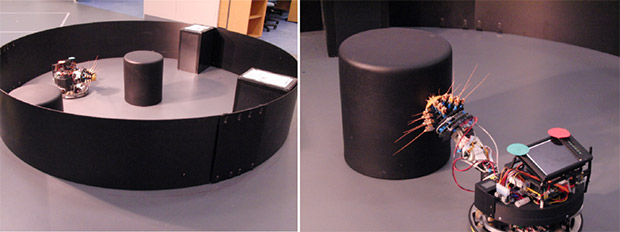
Robots that make maps tend to be highly reliant on vision of one sort or another, whether it’s a camera image or something off the end of the visible spectrum like a laser scanner. This is understandable: humans are adapted to use vision, so we understand it pretty well, and we can get a lot of useful information out of a visual image. Animals, on the other hand, take advantage of a much broader suite of senses, specialized for their environments. If you only come out at night, or if you live in a hole, vision is perhaps not the best solution for you, and a robot modeled after a shrew can now make maps using just tactile feedback from a prodigious set of artificial whiskers…

New research presented at the IEEE International Conference on Robotics and Automation (ICRA) this week has Shrewbot performing what the researchers are calling tSLAM, which is tactile Simultaneous Localization and Mapping. The robot has an array of 18 individually-actuated whiskers mounted on a 3 degree-of-freedom neck, attached to an omni-drive mobile platform. Using a combination of wheel odometry and detection by whisking (the behavior really is called whisking), Shrewbot is able to gradually make a tactile map of an area by combining hundreds (or thousands) of whisk contacts that it feels when it encounters walls or other obstacles.
via IEEE Spectrum


Continue reading 

Leave a Reply

featured blogs
May 6, 2026
Hollywood has struck gold with The Lord of the Rings and Dune'”so which sci-fi and fantasy books should filmmakers tackle next?...

featured paper

Quickly and accurately identify inter-domain leakage issues in IC designs

Sponsored by Siemens Digital Industries Software

Power domain leakage is a major IC reliability issue, often missed by traditional tools. This white paper describes challenges of identifying leakage, types of false results, and presents Siemens EDA’s Insight Analyzer. The tool proactively finds true leakage paths, filters out false positives, and helps circuit designers quickly fix risks—enabling more robust, reliable chip designs. With detailed, context-aware analysis, designers save time and improve silicon quality.

Click to read more

featured chalk talk

Designing Scalable IoT Mesh Networks with Digi XBee® for Wi-SUN
Sponsored by Mouser Electronics and Digi and Silicon Labs
In this episode of Chalk Talk, Quinn Jones from Digi, Chad Steider from Silicon Labs and Amelia Dalton explore how Wi-SUN Micro-Mesh can reduce cost and simplify deployment for your next IoT mesh network. They also investigate the benefits that Digi XBee solutions bring to these types of networks and how you can jump start your next IoT mesh network design with Silicon Labs and Digi.
May 4, 2026
11,161 views




