fresh bytes
Subscribe Now

Nano-sandwich material claimed to boost solar cell efficiency by 175 percent

One of the main reasons that solar cells aren’t more efficient at converting sunlight into electricity is because much of that sunlight is reflected off the cell, or can’t be fully absorbed by it. A new sandwich-like material created by researchers at Princeton University, however, is claimed to dramatically address that problem – by minimizing reflection and increasing absorption, it reportedly boosts the efficiency of organic solar cells by 175 percent.

Developed by a team led by electrical engineer Prof. Stephen Chou, the material is known as a “plasmonic cavity with subwavelength hole array” or PlaCSH.

It consists of five very thin layers. On top is the “window layer” through which the sunlight first passes. It’s made from an extremely fine metal mesh, the diameter and spacing of its holes being measured in nanometers. Next is a layer of transparent plastic, followed by a layer of semiconductive material – although Chou used a plastic semiconductor, other materials could be used. This is followed by a layer of titanium oxide, with a layer of aluminum sitting at the bottom of the stack.
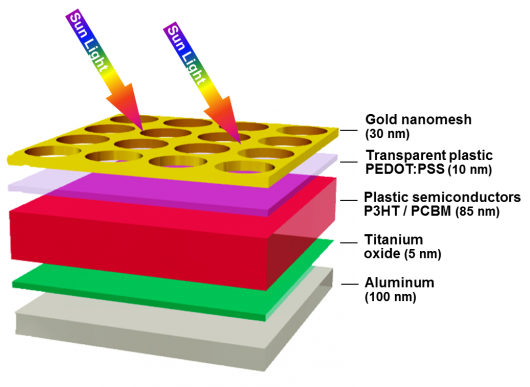
placsh-1.png

via gizmag

Continue reading

Leave a Reply

featured blogs
May 6, 2026
Hollywood has struck gold with The Lord of the Rings and Dune'”so which sci-fi and fantasy books should filmmakers tackle next?...

featured paper

Quickly and accurately identify inter-domain leakage issues in IC designs

Sponsored by Siemens Digital Industries Software

Power domain leakage is a major IC reliability issue, often missed by traditional tools. This white paper describes challenges of identifying leakage, types of false results, and presents Siemens EDA’s Insight Analyzer. The tool proactively finds true leakage paths, filters out false positives, and helps circuit designers quickly fix risks—enabling more robust, reliable chip designs. With detailed, context-aware analysis, designers save time and improve silicon quality.

Click to read more

featured chalk talk

Designing Scalable IoT Mesh Networks with Digi XBee® for Wi-SUN
Sponsored by Mouser Electronics and Digi and Silicon Labs
In this episode of Chalk Talk, Quinn Jones from Digi, Chad Steider from Silicon Labs and Amelia Dalton explore how Wi-SUN Micro-Mesh can reduce cost and simplify deployment for your next IoT mesh network. They also investigate the benefits that Digi XBee solutions bring to these types of networks and how you can jump start your next IoT mesh network design with Silicon Labs and Digi.
May 4, 2026
12,757 views