fresh bytes
Subscribe Now

Mars Opportunity rover reaches Endeavour crater, finds signs of ancient Martian water

Screen_Shot_2012-05-03_at_11.39.23_AM.png

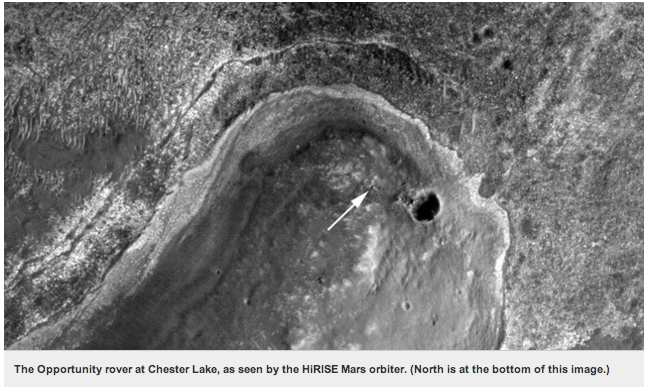
Over seven years into its (originally) 90-day mission, the Mars rover Opportunity arrived at the rim of Endeavour Crater. While the crater itself was formed from an ancient meteorite impact, the rocks at its rim show signs of a watery past. Chemical analysis found deposits typical of hydrothermal vents on Earth, along with features usually associated with evaporation. Together, these pieces of evidence suggest warm, shallow water formerly existed in the region of Endeavour.

In a new Science paper, S. W. Squyres and colleagues describe the process Opportunity used to obtain and analyze the rock samples. The landscape around Endeavour is very old, dating back to the era when Mars was under constant bombardment by meteorites, which is why it was chosen as a site for exploration by rover. If Mars’ history parallels Earth’s in any way, the early cataclysmic period gave way to calmer times, and water—possibly life—may have been present. Based both on the sedimentary and evaporative characteristics of the rocks around the crater, the researchers conclude the region may have been habitable for at least a short period of time.
via ars technica


Continue reading 

Leave a Reply

featured blogs
May 6, 2026
Hollywood has struck gold with The Lord of the Rings and Dune'”so which sci-fi and fantasy books should filmmakers tackle next?...

featured paper

Quickly and accurately identify inter-domain leakage issues in IC designs

Sponsored by Siemens Digital Industries Software

Power domain leakage is a major IC reliability issue, often missed by traditional tools. This white paper describes challenges of identifying leakage, types of false results, and presents Siemens EDA’s Insight Analyzer. The tool proactively finds true leakage paths, filters out false positives, and helps circuit designers quickly fix risks—enabling more robust, reliable chip designs. With detailed, context-aware analysis, designers save time and improve silicon quality.

Click to read more

featured chalk talk

Designing Scalable IoT Mesh Networks with Digi XBee® for Wi-SUN
Sponsored by Mouser Electronics and Digi and Silicon Labs
In this episode of Chalk Talk, Quinn Jones from Digi, Chad Steider from Silicon Labs and Amelia Dalton explore how Wi-SUN Micro-Mesh can reduce cost and simplify deployment for your next IoT mesh network. They also investigate the benefits that Digi XBee solutions bring to these types of networks and how you can jump start your next IoT mesh network design with Silicon Labs and Digi.
May 4, 2026
15,219 views