

fresh bytes
Subscribe Now

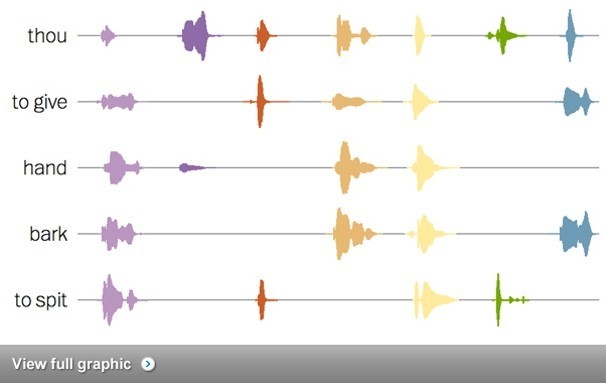
Linguists identify 15,000-year-old ‘ultraconserved words’

words-606-2--606x404.jpg

The traditional view is that words can’t survive for more than 8,000 to 9,000 years. Evolution, linguistic “weathering” and the adoption of replacements from other languages eventually drive ancient words to extinction, just like the dinosaurs of the Jurassic era.

A new study, however, suggests that’s not always true.

A team of researchers has come up with a list of two dozen “ultraconserved words” that have survived 150 centuries. It includes some predictable entries: “mother,” “not,” “what,” “to hear” and “man.” It also contains surprises: “to flow,” “ashes” and “worm.”
via The Washington Post


Continue reading 

Leave a Reply

featured blogs
Feb 24, 2026
How a perfectly good Bosch HVAC system was undermined by preventable mistakes, and a thermostat interface that defies logic....

featured video

Cadence Chiplets Solutions | Helping you realize your chiplet ambitions

Sponsored by Cadence Design Systems

In this webinar, David Glasco, VP of Compute Solutions at Cadence, discusses how Cadence enables customers to transition from traditional monolithic SoC architectures to modular, scalable chiplet-based solutions, essential for meeting the growing demands of physical AI applications and high-performance computing.

Read eBook: Helping You Realize Your Chiplet Ambitions

featured chalk talk

Global Coverage With NTN
In this episode of Chalk Talk, Paul Fadlovich from TE Connectivity and Martin Lesund from Nordic Semiconductor and Amelia Dalton explore the what, why and how of NTN technology. They also explore the role that antennas play in satellite communication systems, and how Nordic Semiconductor’s nRF9151 System-in-Package and TE Connectivity’s broad range of antenna solutions can jump start your next global IoT design.
Feb 19, 2026
6,980 views



