

fresh bytes
Subscribe Now

Flying robot picks itself up and relaunches after crashing

epfluav.jpg

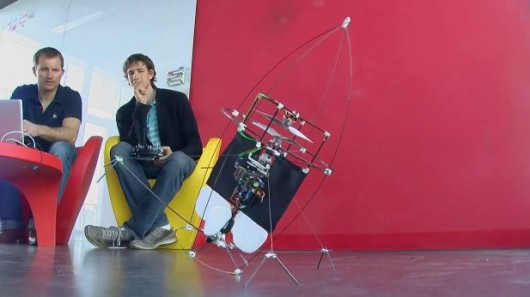
Researchers from the Laboratory for Intelligent Systems at Switzerland’s EPFL federal research institute were inspired by the resilience of flying insects, and set out to replicate it in a miniature unmanned aerial vehicle. They succeeded, creating a UAV that can crash into things, fall down, then right itself and get back in the air.

All of the aircraft’s propellers, electronics and other flight surfaces are contained within an open, flexible carbon fiber frame. This protects them in the event of a collision, while still offering some give, so the frame doesn’t just break on impact. The choice of carbon fiber also allows the UAV to remain as lightweight as possible.

When it does fall sideways onto the floor, four carbon fiber legs automatically extend symmetrically from its sides, pushing it back up into its upright “ready for take-off” stance. This is known as its Active Recovery System, and allows it to return to the air as fast as possible.
via Gizmag


Continue reading 

Leave a Reply

featured blogs
May 6, 2026
Hollywood has struck gold with The Lord of the Rings and Dune'”so which sci-fi and fantasy books should filmmakers tackle next?...

featured paper

Quickly and accurately identify inter-domain leakage issues in IC designs

Sponsored by Siemens Digital Industries Software

Power domain leakage is a major IC reliability issue, often missed by traditional tools. This white paper describes challenges of identifying leakage, types of false results, and presents Siemens EDA’s Insight Analyzer. The tool proactively finds true leakage paths, filters out false positives, and helps circuit designers quickly fix risks—enabling more robust, reliable chip designs. With detailed, context-aware analysis, designers save time and improve silicon quality.

Click to read more

featured chalk talk

Designing Scalable IoT Mesh Networks with Digi XBee® for Wi-SUN
Sponsored by Mouser Electronics and Digi and Silicon Labs
In this episode of Chalk Talk, Quinn Jones from Digi, Chad Steider from Silicon Labs and Amelia Dalton explore how Wi-SUN Micro-Mesh can reduce cost and simplify deployment for your next IoT mesh network. They also investigate the benefits that Digi XBee solutions bring to these types of networks and how you can jump start your next IoT mesh network design with Silicon Labs and Digi.
May 4, 2026
13,778 views




