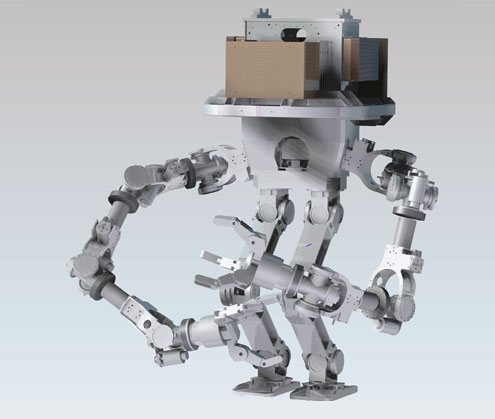
Yesterday, the Department of Defense’s advanced research arm, DARPA, announced the details of its next grand challenge. Following up on its autonomous vehicle challenge, the research agency will now focus on robots that do need an operator. But these robots are meant to operate in what DARPA calls “degraded” environments—basically, disaster zones of various flavors—where bandwidth between the operator and the robot won’t be guaranteed.
DARPA’s Dr. Gill Pratt, who described the program earlier this week, said the goal of the grand challenge was to help the DOD fulfill one of its 10 mission roles—the ability to provide humanitarian aid and disaster relief. But the agency’s thinking was clearly influenced by the Fukushima disaster. “During the first 24 hours [of Fukushima], there were several opportunities for intervention to help make the disaster less severe,” Pratt said, “but unfortunately, people could not go in to that zone because the radiation was too high, and as a result, the disaster was worse than it could have been.”
The DARPA robots therefore must operate in what Gill termed an “engineered” environment, “not a random, unstructured outdoor environment.” Such an environment is likely to include tools, so the robot will be expected to navigate doors and stairways and use everything from screwdrivers to vehicles. Again using Fukushima as a point of reference, Gill mentioned that fire trucks were used in high-radiation areas at the site, a task that could have been handled more safely and thoroughly if humans weren’t involved.
via ars technica