



Before we start, I should note that I always enjoy chatting with company representatives for these columns—although, in some cases, we may be asking the word “enjoy” to do some heavy lifting. Happily, conversations with folks like Kyle Fox, Senior Director at NXP Semiconductors, require no such linguistic gymnastics.
On the off chance you don’t know, NXP Semiconductors is a Dutch semiconductor manufacturer that spun out of Philips’ semiconductor division in 2006. The “NXP” originally stood for “Next eXPerience,” but these days it’s become the brand embraced by the unwashed masses, of whom I’m a proud, card-carrying member.
Although the company’s headquarters are in Eindhoven, Netherlands, NXP has a global presence. For example, it operates four wafer fabrication facilities here in the USA, with two in Austin, Texas, and the other two in Chandler, Arizona. This explains why Kyle was calling from Austin, which is an awesome place to hang one’s hat.
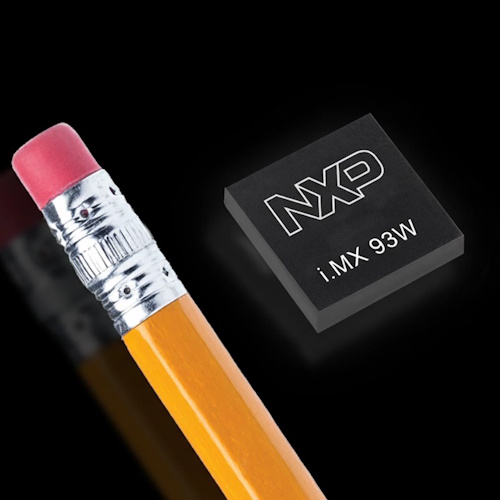
The purpose of our conversation was for Kyle to bring me up to date with NXP’s recently announced i.MX 93W SoC. Kyle noted that he prefers a face-to-face video call for this briefing because “the hardest thing I have to do is to convey just how small this sucker is.” He then brought up the image below, saying, “We spent hours trying to decide on something that everybody could recognize, trying all sorts of things like coins and paper clips before eventually settling on a number two pencil.”
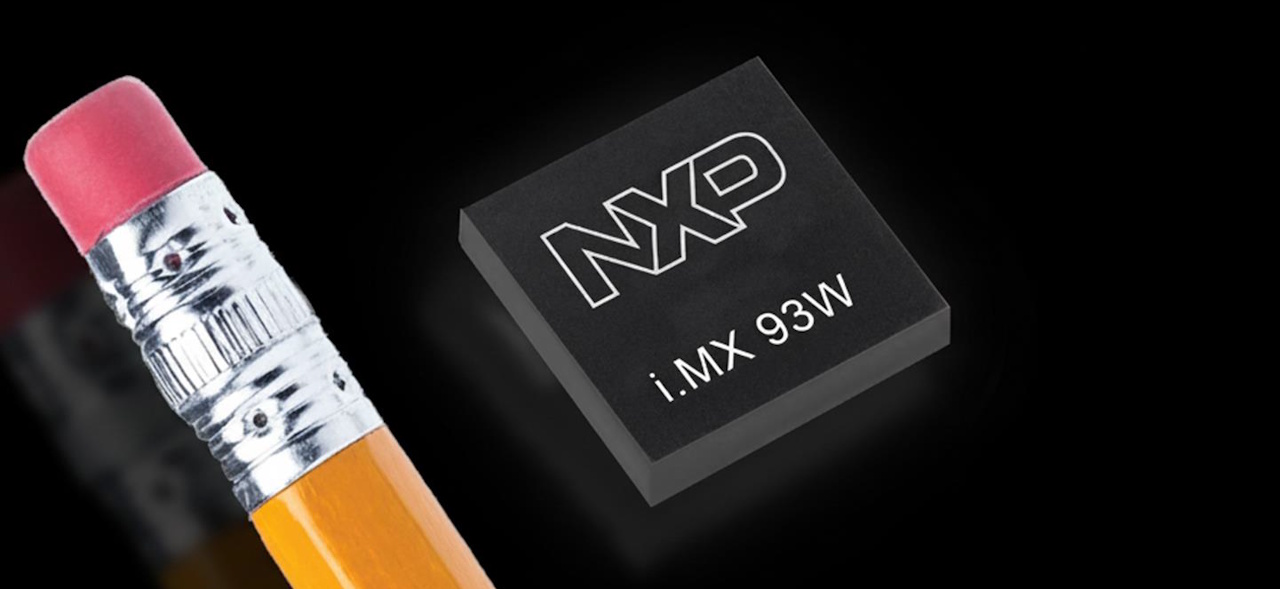
Meet the i.MX 93W applications processor (Source: NXP)
I fear this may have been Kyle’s big mistake. As soon as I saw this classic yellow No. 2 pencil, I had a flashback to a comic-book debate I once saw on TV. The topic was superhero weaknesses and inconsistencies, and the conversation turned to the Green Lantern.
The first (“Golden Age”) Green Lantern was Alan Scott, a railway engineer who came into possession of a magic lantern, which he later fashioned into a ring. You must admit that being called the “Green Lantern” has more gravitas than being called the “Green Ring” (I’m desperately fighting the temptation to say “it has more of a ring to it”).
Later came the (“Silver Age”) Green Lantern, Hal Jordan. As a tiny tidbit of trivia, Hal’s physical appearance, according to the artist Gil Kane, was modeled after Paul Newman, who had once been one of Gil’s neighbors.
Returning to the aforementioned debate, someone noted that the Golden Age Green Lantern’s weakness was wood, while the Silver Age Green Lantern’s Achilles’ heel was the color yellow. This prompted one of the debaters to observe, “So… one’s weak against yellow, the other against wood—meaning I could take them both out with a No. 2 pencil!”
And you thought I’d lost the thread, but we digress…
Kyle proudly proclaimed that the i.MX 93W SoC is the industry’s first applications processor (AP) to combine a general-purpose central processing unit (CPU), a dedicated AI neural processing unit (NPU), and tri-band radio capability. He also noted that it’s targeted at a wide swath of applications, including robotics, home automation, building automation, factory automation, healthcare, and power and energy management.

“Hold hard,” I cried, “I’m not as stupid as I look!” (Who could be?) “Just a few weeks ago,” I continued, “I posted a column about the SYN765x from Synaptics, which also boasts a CPU, NPU, and tri-band radio” (see When AI Comes Home to Roost). “Ah ha,” Kyle responded, but the SYN765x is fundamentally a microcontroller capable of running bare metal code or a real-time operating system (RTOS), while the i.MX 93W is a high- end applications processor capable of handling a full Linux environment, such as Ubuntu.”
This is the point where I started to get a feel for what was really going on here. On the surface, it’s tempting to think of the i.MX 93W as “just another application processor with some wireless thrown in,” but it’s much more interesting than that.
What we’re seeing is another example of the emergence of physical AI—that is, intelligence embedded directly into real-world devices rather than sitting in some distant data center (see What the FAQ are Perceptive, Enhancive, Assistive, Generative, Agentic, and Physical AI)—and this is where things start to get interesting.
Traditionally, if you wanted to build an intelligent edge device, your “shopping list” would look something like the following:
An applications processor.
An external AI accelerator (maybe).
A Wi-Fi module
A Bluetooth module
An 802.15.4 radio
A small forest of RF support components
Several months of certification pain
As the folks at NXP point out, fragmented designs like this increase cost, increase complexity, and—perhaps most painfully—slow deployment. And all this is before you even start writing code.
During our conversation, Kyle kept circling back to what he cheerfully described as a “just add water” experience. In essence, this refers to the users’ ability to put the chip down, add an antenna (or two), and get on with their lives.
What the i.MX 93W is really doing is collapsing all the traditional complexity into something approaching a drop-in building block. Inside a single compact package (about the size of—yes—a pencil eraser), you get:
A dual-core Arm Cortex-A55 applications processor capable of running full Linux.
A dedicated NPU delivering around 1.8 eTOPS of AI performance.
Integrated tri-radio connectivity (Wi-Fi, Bluetooth, and 802.15.4).
Hardware security via NXP’s EdgeLock enclave.
But, as good as this is, it’s still only half the story. Much like the Green Lantern, the i.MX 93W has a hidden superpower—making the RF someone else’s problem. If you’ve ever worked on a wireless design, you’ll know that the silicon is often the easy part. The real pain comes from things like antenna design, RF tuning, and regulatory certification (which can take months).
NXP’s answer is to wrap all of this into pre-certified reference designs covering multiple regions, allowing developers to sidestep much of the traditional RF complexity. In other words, they’re not just integrating silicon, they’re integrating time.
Another key takeaway from my conversation with Kyle is that not all AI needs to be… well… ChatGPT-sized. In fact, most real-world applications don’t. Instead of giant multi-billion-parameter models, what we’re increasingly seeing are small, highly specialized models trained for very specific tasks like the following:
Detecting subtle changes in airflow in an HVAC system.
Predicting compressor failures before they happen.
Optimizing energy usage in real time.
Managing distributed power flows in smart grids.
These are all problems where latency matters, connectivity isn’t guaranteed, and power and cost constraints are real. And this is exactly where a “just add water” platform like the i.MX 93W comes into its own.
One of Kyle’s examples that stuck with me involved modern air conditioning systems. These are no longer simple “on/off” devices. Instead, they’re evolving into intelligent systems capable of analyzing patterns over time and making decisions—sometimes counterintuitive ones—to improve efficiency.
In one case, a system trained on a year’s worth of data discovered that cycling the compressor on and off during peak periods could maintain the same cooling performance while reducing energy consumption. That’s not something you’d program intuitively. It’s something you need to learn. And it’s exactly the sort of task that a compact, connected, “just add water” AI platform like the i.MX 93W is designed to handle.
If I were to wax philosophical, as is my wont, I would say it’s becoming increasingly clear that the future won’t be defined by a handful of massive AIs guzzling gobs of power in distant server farms, but rather by countless smaller intelligences embedded in the fabric of our everyday lives, each one focused, purposeful, and—if we’re lucky—effective at the task at hand (perhaps the first tentative steps toward the sort of future depicted in The Last Human by Zack Jordan).
Platforms like the i.MX 93W won’t make headlines in the same way as the latest trillion-parameter frontier model, but they may ultimately prove to be just as important. After all, it’s one thing to imagine a world of physical AI—it’s quite another to make it practical. And if we can get even a little closer to a “just add water” experience along the way, then that’s a future I, for one, will happily raise my (No. 2) pencil in salute.







