



I recently received an email that essentially said something like, “Interested in physical AI, agentic AI, robotic ships, autonomy, maritime, offshore, subsea, security, ocean science… [the list went on]? If so, get in touch!”
Let’s take a step back before we race forward. Someone recently asked me how my “triage process” works for people pitching potential articles to me. I’d never really thought about this before, but there are certainly several ways to turn me off before we start.
One is to call me “Clive” (my given name used only by my family) rather than “Max” (how I’m known outside of my family). In fact, my wife, Gina the Gorgeous, didn’t even know that Max wasn’t my real name until shortly before we were married. Another is to waffle about things of a business nature—an “exciting” new round of funding, a “thrilling” collaboration, or the “astonishing” appointment of Professor Cuthbert Dribble to the position of Global Director of Strategic Thought Leadership—by which time my eyes have glazed over and (what I laughingly call) my mind is drifting off to a happier place involving mugs of hot tea and piles of bacon sandwiches.
By comparison, when someone starts with, “Interested in physical AI, agentic AI, robotic ships, autonomy, maritime, offshore, subsea, security, ocean science…” I find myself slavering like a Pavlovian mutt, which is how I came to find myself chatting with Luciano Belviso, the CEO and Co-founder of Mirai Robotics.
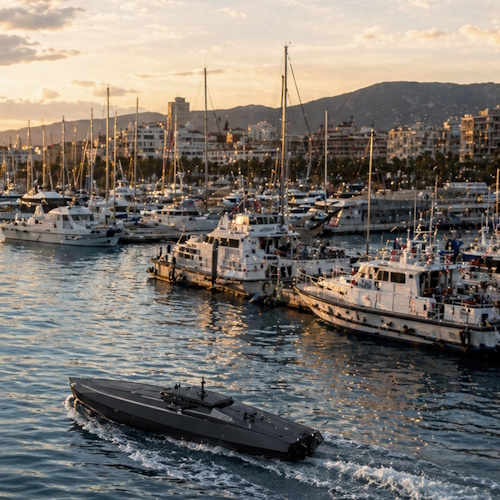
Luciano took a deep breath and explained that “Mirai Robotics is a Physical AI company building software-defined robotic systems and AI-driven information intelligence platforms that integrate vessel, sensing, autonomy, and command into a single operational system designed to run continuously in real-world maritime conditions.” (Phew!) He even showed me the image of one of their prototype vessels as seen (or not seen) below. Unfortunately, the company has only recently come out of stealth mode, and it would appear that the guys and gals in charge of graphics haven’t received that memo yet.

A stealthy view of a stealthy autonomous sensor platform (Source: Mirai Robotics)
People often think about the world’s oceans in terms of scenery (a nice blue backdrop for postcards), cruise ships, and the occasional giant squid. However, another way to think about things is that the oceans are infrastructure… vast, critical, civilization-scale infrastructure. In fact, you could argue that they are the largest infrastructure on Earth.
More than 80% of global trade moves by sea. Most international internet traffic—almost all of it, in fact—flows through subsea cables lying on the seabed. And according to the Organization for Economic Co-operation and Development (OECD), the “Blue Economy” (i.e., the sustainable use of ocean resources for economic growth, improved livelihoods, and jobs while preserving the health of marine ecosystems) could exceed $3 trillion by 2030. That’s not a niche market. That’s planetary-scale plumbing.
And yet… for something so important, the oceans remain astonishingly under-instrumented. Contrast this to airspace, which is heavily observed, highly controlled, and continuously monitored. If something unexpected enters controlled airspace, people know and respond… quickly. By comparison, what we might call “waterspace” is un diverso bollitore di pesci (“a different kettle of fish,” as the idiomatic English phrase would have it).
If you’re thinking un diverso bollitore di pesci sounds insane in Italian, you’d be right. But I’d counter by noting that the Italians say È un altro paio di maniche (“that’s another pair of sleeves”), which arguably makes no more sense.
Ma divago (but I digress)…
The point is that we know where aircraft are. We track them obsessively. But at sea, surprisingly few objects are persistently observed. Ships can turn off transponders. “Ghost fleets” can operate in the shadows. Critical infrastructure—ports, offshore platforms, pipelines, undersea cables—may be monitored only intermittently. And more than 70% of the seabed remains unmapped (all the more reason to fully map Mars while we have the chance before we terraform it and add an ocean—see also Should We Terraform Mars?). Meanwhile, the maritime sector faces a projected shortage of roughly 90,000 certified merchant marine officers. The current model doesn’t merely strain—it simply doesn’t scale.
That’s not a temporary imbalance; it’s a systems problem, and systems problems tend to invite systems solutions. Mirai’s solution isn’t about boats with sensors bolted on; it’s about sophisticated sensor suites that happen to be on boats. We’re talking about an almost ridiculously rich sensor stack—optical and infrared cameras, radar, LiDAR, active and passive sonar—fused into a coherent operational picture. But the real trick is not the sensors themselves; it’s combining those streams to infer behavior, identify anomalies, and support autonomous mission decisions.
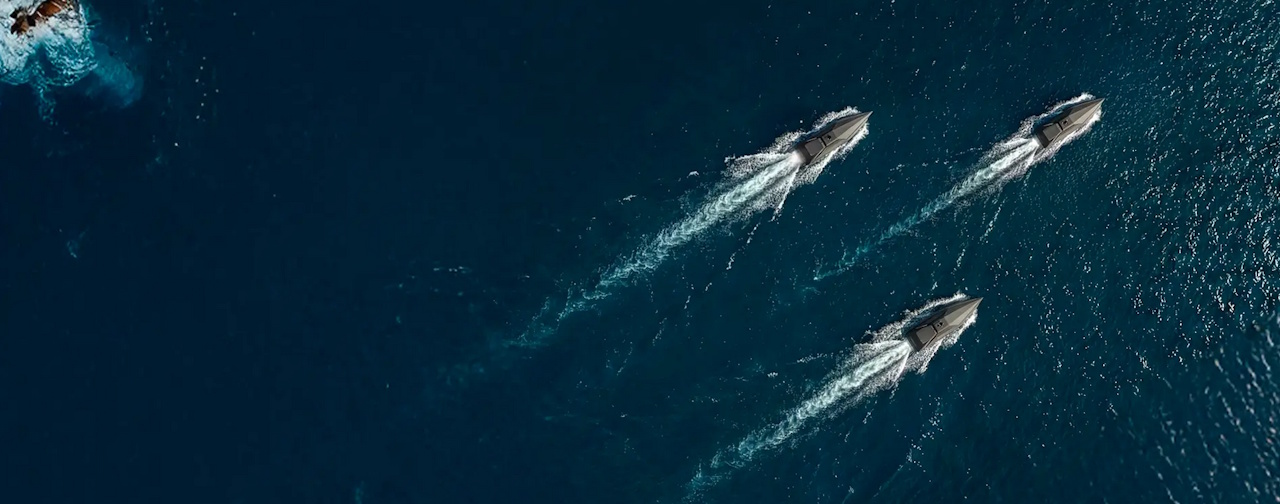
Imagine a future in which autonomous ships patrol the oceans (Source: Mirai Robotics)
What intrigues me about Mirai isn’t simply “robot boats” (although the cool factor of autonomous craft is hard to deny), but rather the shift in thinking. Traditionally, surveillance has been about recognizing objects: “There’s a boat… and a diver… and a floating container.” Mirai is pushing toward recognizing behavior. That’s a different kettle of… but enough of that. A fishing boat isn’t suspicious because it looks suspicious. It becomes suspicious because it’s loitering over a subsea cable, rendezvousing with another vessel at an odd location, or moving in a pattern that doesn’t make nautical or commercial sense.
That requires much more than simple detection. It requires sensor fusion, edge intelligence, pattern recognition, and mission autonomy. This is where multiple flavors of AI collide in interesting ways. Perceptive AI watches the world through radar, cameras, infrared, sonar, and other sensors. Enhancive AI cleans up and fuses those streams into something meaningful. Agentic AI turns high-level intent, such as “patrol this area and report anomalies,” into meaningful actions. And Physical AI closes the loop, allowing autonomous systems to sense, decide, and act in the real world. Mirai appears to be playing in all four domains at once. That’s ambitious. It’s also, I suspect, where this all needs to go.
Mirai’s thesis is not “let’s build an autonomous vessel.” It’s closer to “let’s build an operating layer for the maritime domain,” which is a much bigger idea. Their approach spans autonomous vessels, onboard edge compute, mission software, fleet coordination, and an intelligence layer designed to reason about what is happening across large swathes of the ocean.
We’re not talking about isolated point solutions; rather, we’re envisaging an ecosystem. Irrespective of how many sensors it boasts, a 10-meter autonomous patrol craft becomes more interesting when it’s part of a distributed robotic network. One vessel sees something. Another picks up the track. A third contributes sonar or optical context. Higher-level AI reasons about the underlying patterns. And human operators, still very much in the loop, can intervene when needed. Think air traffic control… but with autonomous sensor platforms spread across “waterspace.”
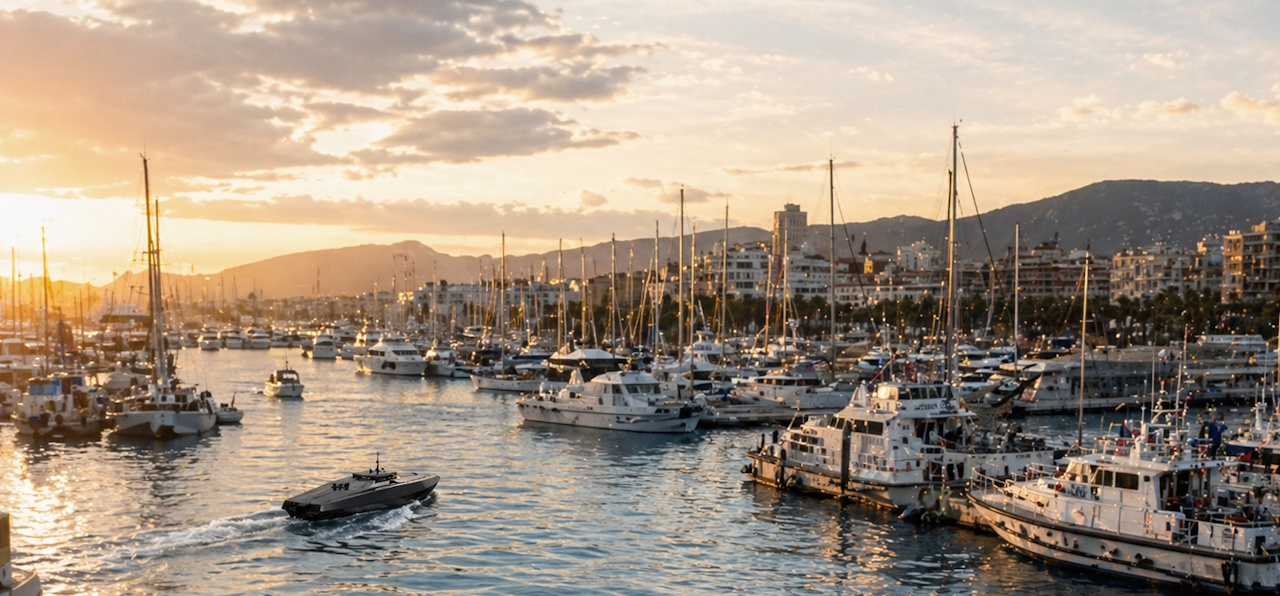
Protecting our harbors from bad actors (Source: Me and ChatGPT)
Why does any of this matter? Well, security is an obvious application… protecting harbors, monitoring offshore energy assets, watching undersea cables and pipelines, countering illegal fishing, and detecting small autonomous threats, including aerial, surface, and subsurface drones. In a crunchy nutshell, this is about providing persistent intelligence, surveillance, and reconnaissance (ISR), rather than today’s largely sporadic visibility.
And there’s a broader story involving ocean science, environmental monitoring, infrastructure inspection, autonomous logistics, and search-and-rescue. Once we can make the ocean continuously observable, entirely new categories of applications emerge.
I love the idea of turning the sea from an opaque environment into something increasingly knowable. I also love the idea of human-in-the-loop (HIL) using mixed-reality interfaces in which an operator can effectively “see” what the vessels see, stepping into a synthesized operational picture assembled from distributed sensor data.
Luciano closed our chat by saying, “For centuries, humans have built ships, but now we need to build systems.” That captures this whole story in a single sentence. Mirai Robotics is betting the future of maritime operations won’t be defined by bigger ships or more crew. Rather, it will be defined by persistent robotic systems, AI-driven intelligence, and what may amount to an operating system for the ocean itself.
If all this sounds a little like science fiction, well, so did radar once, and GPS, and autonomous aircraft, and many other things we now take for granted. Luciano could be right; it may well be that the next great infrastructure revolution doesn’t happen on land or in the air, but across “waterspace.” Perhaps we are watching the birth of something rather big (or rather wet). What say you?







