When I was a kid growing up in the 1960s, I fully believed that humans could live on both Mars and Venus without requiring special suits or survival gear. This was because I had discovered the wonderful world of science fiction. Many of the books I devoured (figuratively speaking) described Mars as a dusty frontier world with a thin, dry atmosphere. By comparison, Venus was portrayed as a foggy, steamy, swampy jungle planet. Although both planets were depicted as being home to intelligent races, Mars was typically represented as having a truly ancient civilization.
I’m thinking of classics like Robert A. Heinlein’s Between Planets (1951), Red Planet (1949), and Space Cadet (1948), and Ray Bradbury’s The Martian Chronicles (1950). Later, I read all the John Carter books in the series by Edgar Rice Burroughs, commencing with A Princess of Mars (1912), which featured a dying but breathable Mars (“Barsoom”) with a captivating mix of canals, ruined cities, and sword fights. Later still, I was introduced to C. S. Lewis’s Out of the Silent Planet (1938), in which Mars (“Malacandra”) is inhabited and astonishingly alive, and Perelandra (1943), where we are introduced to a lush Venus that’s almost Edenic.
None of these misrepresentations was the fault of the authors. Venus was permanently shrouded in bright clouds, and no one could see what lay beneath with terrestrial telescopes in the 1800s and 1900s. As every mystery invites imagination, people happily filled in the blanks. Since Venus is closer to the Sun and receives nearly twice Earth’s sunlight, 19th- and early 20th-century thinkers reasoned that it was hotter than Earth. Because clouds on Earth imply water, astronomers assumed that Venus’s clouds were likewise formed from water vapor and not—as it eventually turned out—sulfuric acid droplets (surprise!). In turn, this led them to think “lots of water,” which in turn led them to envision jungles, swamps, and (just maybe) giant reptiles.
Meanwhile, in 1887, the Italian astronomer Giovanni Schiaparelli observed long lines on Mars and called them “canali” (Italian for “channels”). Unfortunately, the word was mistranslated into English as “canals,” leading people to speculate that they were artificial structures built by intelligent Martians.
In 1895, the American astronomer Percival Lowell popularized the idea in books, arguing that the canals were irrigation systems built by a dying Martian civilization. It was around this time that H. G. Wells wrote The War of the Worlds (first serialized and then published as a book). All these factors helped shape the popular perception of Mars, especially after Orson Welles directed and narrated a radio broadcast version of The War of the Worlds on October 30, 1938, thereby convincing some listeners that a Martian invasion was actually taking place (silly Americans).

Orson Welles explaining to reporters how no one connected with the War of the Worlds radio broadcast had any idea the show would cause panic (Source: Wikipedia/Public Domain)
But we digress… Over time, the dreams began to die, starting with Venus. In 1962, the American Mariner 2 performed a Venus flyby, making it the first robotic space probe to report successfully from a planetary encounter. Unfortunately, this flyby revealed that the surface of Venus was blisteringly hot (hundreds of °C) and that this was very much not a habitable tropical world. Later, in 1967, the Russian Venera 4 probe delivered the coup de grâce when it sampled Venus’s atmosphere directly and showed it was mostly carbon dioxide, crushingly dense, and utterly unbreathable.
In the case of Mars, while it’s true that studies from the 1920s to the 1940s indicated that this planet had only a thin arid atmosphere, it was still popularly assumed that we would be able to survive the experience. The rude awakening came with Mariner 4. In its 1965 flyby of Mars, this probe revealed a cratered, Moon-like world whose very thin atmosphere (~6 millibars, less than 1% of Earth’s) had far too little pressure for humans to breathe—or even for water to persist on the surface. This was when romantic visions of Barsoom really took a serious hit.
Having said this, we now know that Mars was once a water-rich world with a much thicker and warmer atmosphere. The idea that “Mars may once have had lots of water” had been floating around (no pun intended) since the late 1800s, but the game-changer came with Mariner 9 in 1971. As the first robotic space probe to orbit another planet, Mariner 9 found giant dried-up river channels, flood-carved terrains, ancient valleys, and possible deltas.
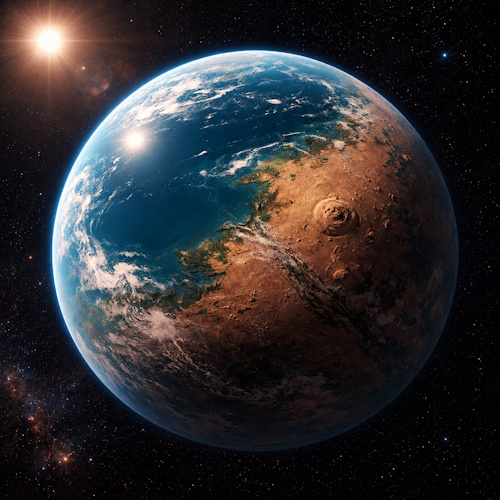
Since that time, evidence has been mounting for the Mars ocean hypothesis, which postulates that nearly a third of Mars’s surface was covered by an ocean of liquid water several billion years ago.
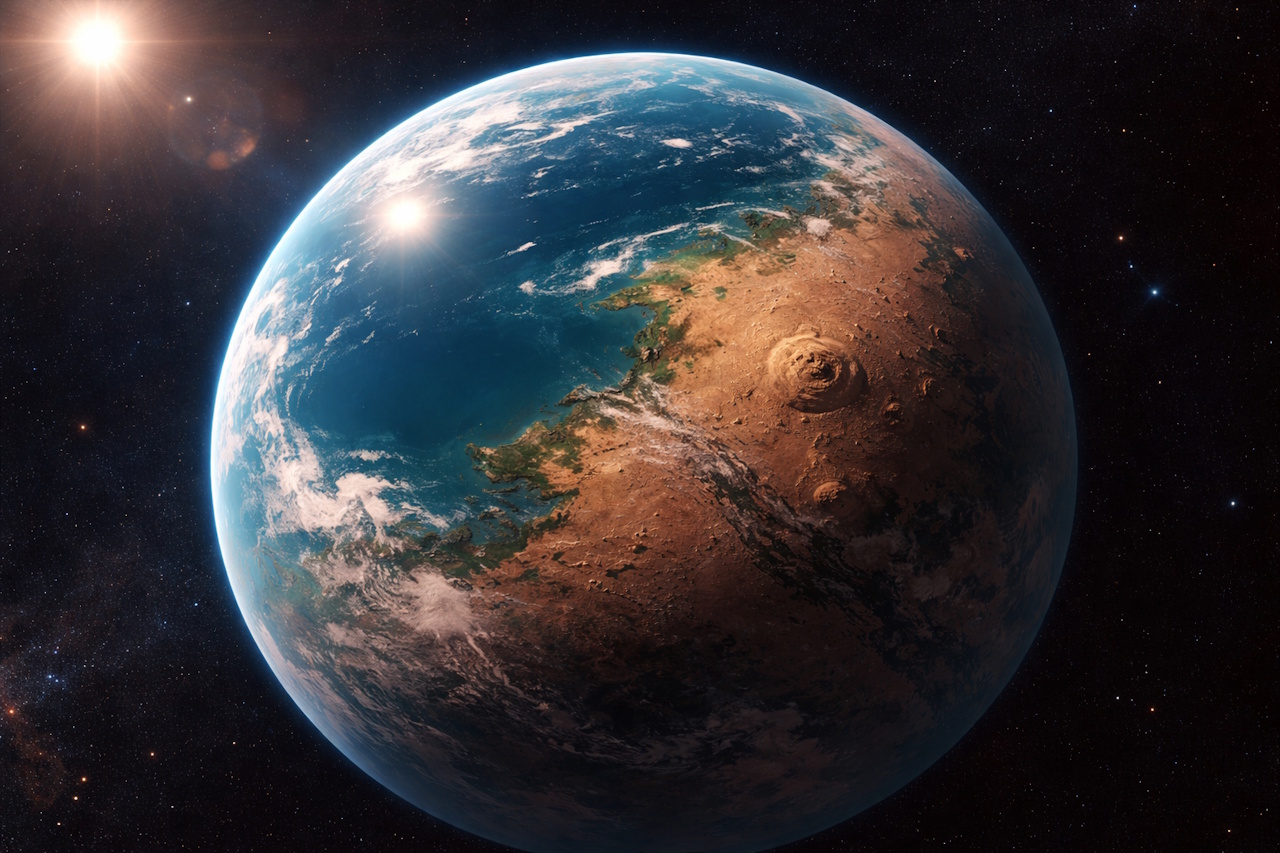
Mars as it may have appeared billions of years ago (Source: Me and ChatGPT)
I don’t know about you, but just looking at the image above makes me want to travel billions of years back in time, transport myself to Mars, and sail around this primordial ocean, which we could call Mare Maximus or Oceanus Maxfieldii (said Max, modestly).
Of course, just saying this makes me think I could save myself a lot of effort and travel by simply staying here on Earth, popping back just 85 million years, and sailing around the North American inland sea. I am, of course, referring to the Western Interior Seaway, whose heyday was during the Cretaceous Period. At that time, a shallow inland sea split North America into two landmasses: Laramidia to the west and Appalachia to the east, as illustrated below.
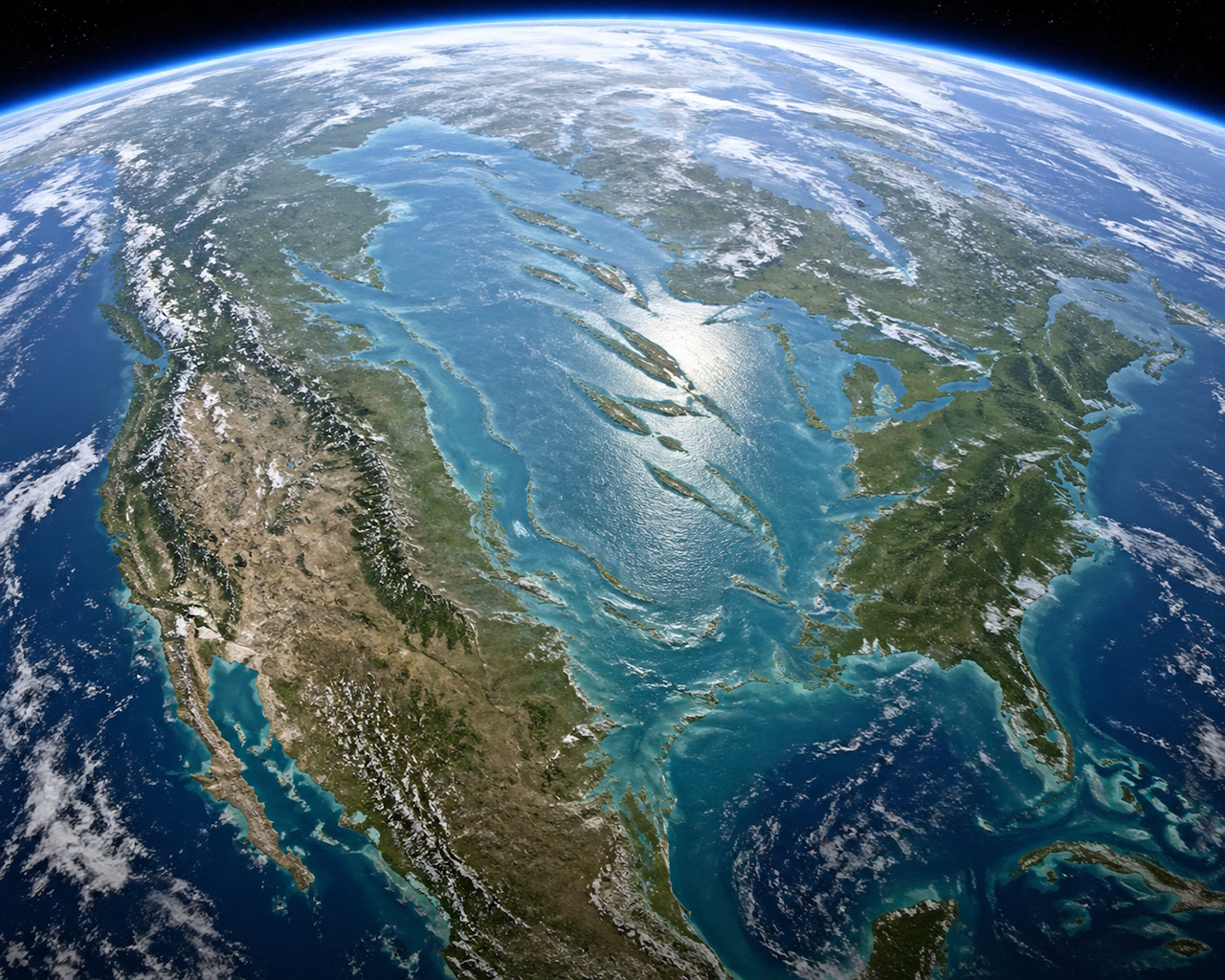
When Kansas had a coastline. The North American inland sea ~70 to 100 million years ago (Source: Me and ChatGPT)
I can’t help myself…I’m on a roll. Now I’m thinking of Ancient Shores by Jack McDevitt. In a crunchy nutshell, a fellow named Tom discovers a yacht buried on his landlocked farm in North Dakota. It turns out this vessel has been entombed for some 10,000 years (being fashioned from an alien material has helped it stand the test of time). This takes us back to the days of Lake Agassiz—a gigantic glacial lake that existed at the end of the last Ice Age. Covering parts of what we now call North Dakota, Minnesota, Manitoba, Saskatchewan, and Ontario, Lake Agassiz was larger than all the Great Lakes combined.
It isn’t long before our hero and his friends ask themselves, “If we had a yacht 10,000 years ago, where would we have put the boathouse (assuming we didn’t drift too far before we sank)?” That line of reasoning leads them to a buried structure that proves to be a still-functioning gateway to alien worlds. Apparently, the ancient aliens treated Earth as a sort of long-weekend vacation spot. Of course, it’s not long before someone decides to see what’s on the other side of the gateway, at which point… but no! You’ll have to discover this for yourself.
And so, finally, this is where we come to the crux of my current cogitations. If we ever manage to become a Type I+ civilization on the Kardashev scale, thereby affording us the ability to terraform Mars, should we do so?
Imagine the picture of Mars with an ocean shown earlier, not depicting a scene from billions of years ago, but instead showing how things could be in the not-so-distant future.
Where would we get the water? I’m glad you asked. One possibility is to attach rocket engines to icy bodies roaming the outer solar system, fly them back to Mars using some of the ice as reaction mass for the rockets, and crash what’s left into the planet. Alternatively, there’s Ceres in the asteroid belt. At ~590 miles in diameter, this dwarf planet is thought to be 20–30% water by mass, which equates to ~50 million cubic miles of water (I’m rounding like a man possessed).
Sticking with Freedom Units, Mars’s total surface area is ~60 million square miles, so a third of this area (the original ocean) would be about 20 million square miles. Even my poor math tells me that 50 million cubic miles divided by 20 million square miles means the new Martian ocean would average about 2.5 miles deep—an Oceanus Maximus indeed.
Don’t ask me how we would do this—I’m a busy man, and I can’t be responsible for every nitty-gritty detail—but the question remains: just because we may one day be able to do it, should we do it?
As is so often the case, I find myself sitting on the fence, seeing and agreeing with both sides of the argument. On the one hand, I’m inclined to think we should leave things as they are. Mars is a world with its own history, its own geology, and perhaps even its own dormant—or extinct—biology. There’s something faintly vandalistic about taking an entire planet, however barren it may appear, and remaking it to suit ourselves before we fully understand what is already there.
One might even argue that we have a moral duty not to turn another world into a cosmic real estate development. Some may regard Mars as a scientific time capsule of early solar system history. And there’s certainly an argument that we’ve made enough of a hash of one biosphere, so perhaps we should hesitate before “improving” a second.
On the other hand, I can’t help thinking there’s no point having a perfectly good planet sitting there underutilized, not least that I would really like to sail my imaginary yacht around the Cape of Max Good Hope and have a barbecue on the unsullied sands lining the Bay of No Regrets.
What say you? Should we leave Mars untouched as a scientific treasure and potential cradle of alien secrets, or would it be better to transform it into a new world for future generations? As always, I’d love to hear any thoughts you’d care to share.