fresh bytes
Subscribe Now

Zombie spider builds a stronger web for the parasitic wasp that’s sucking its blood

Screen_Shot_2015-08-06_at_9.31.03_AM.0.png

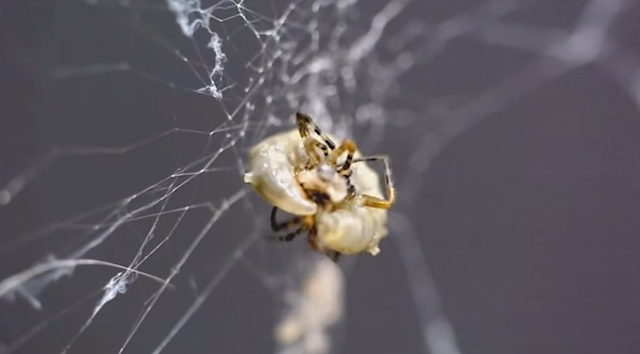
By hijacking a spider’s nervous system, a wasp larva can manipulate the spider into making a stronger web, according to a study published yesterday in The Journal of Experimental Biology. Of course, that’s right before the larva kills the enslaved spider its been feeding on for days — and uses the web to make a cocoon.

There’s nothing subtle about the way in which the Reclinervellus nielseni wasp larva takes control of the Cyclosa argenteoalba spider’s nervous system. First, an adult female wasp must attack a spider so it can lay an egg on the spider’s abdomen. When the egg hatches, the wasp larva feeds itself by sucking on the spider’s hemolymph — the insect equivalent of blood. This is probably where the mind control starts to happen; researchers think the larva “injects” the spider with substances that alter its web-building behaviors. So, when the larva’s done growing, it manipulates the spider into making a special type of web. As soon as the task is complete, the larva molts, kills the spider, and spins the altered web into a hanging cocoon that it can chill in for about 10 days while it develops.
via The Verge


Continue reading 

Leave a Reply

featured blogs
Apr 2, 2026
Build, code, and explore with your own AI-powered Mars rover kit, inspired by NASA's Perseverance mission....

featured paper

Quickly and accurately identify inter-domain leakage issues in IC designs

Sponsored by Siemens Digital Industries Software

Power domain leakage is a major IC reliability issue, often missed by traditional tools. This white paper describes challenges of identifying leakage, types of false results, and presents Siemens EDA’s Insight Analyzer. The tool proactively finds true leakage paths, filters out false positives, and helps circuit designers quickly fix risks—enabling more robust, reliable chip designs. With detailed, context-aware analysis, designers save time and improve silicon quality.

Click to read more

featured chalk talk

Connecting the World Through Space
Sponsored by Mouser Electronics and Qorvo
In this episode of Chalk Talk, Ryan Jennings from Qorvo and Amelia Dalton explore the critical components and design challenges inherent in LEO satellite infrastructure and how Qorvo’s solutions are enabling the next generation of space-based connectivity. 
Mar 30, 2026
22,275 views