

fresh bytes
Subscribe Now

Wired Science space photo of the day: Curiosity’s landing site

galecrater.jpg

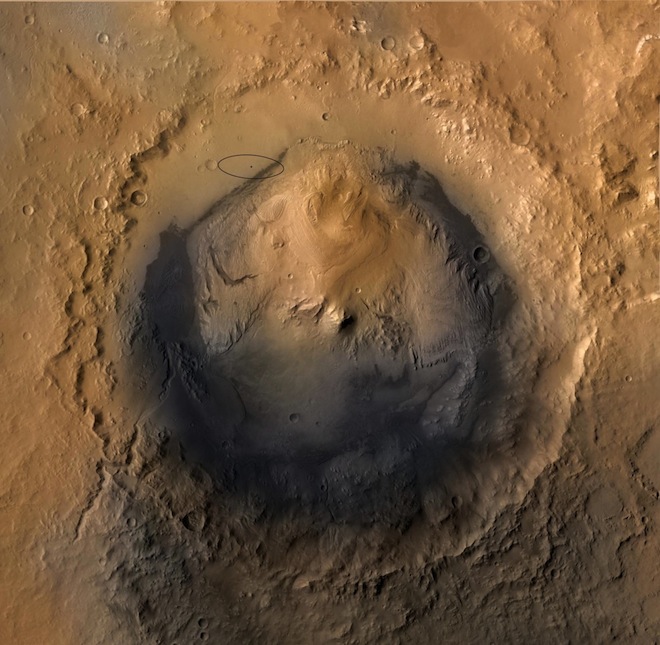
As of June 2012, the target landing area for NASA’s Mars Science Laboratory mission is the ellipse marked on this image of Gale Crater. The ellipse is about 12 miles long and 4 miles wide (20 kilometers by 7 kilometers).

This view of Gale Crater is derived from a combination of data from three Mars orbiters. The view is looking straight down on the crater from orbit. Gale Crater is 96 miles (154 kilometers) in diameter. Mount Sharp rises about 3.4 miles (5.5 kilometers) above the floor of Gale Crater. Stratification on Mount Sharp suggests the mountain is a surviving remnant of an extensive series of deposits that were laid down after a massive impact that excavated Gale Crater more than 3 billion years ago. The layers offer a history book of sequential chapters recording environmental conditions when each stratum was deposited.
via Wired

Continue reading 

Image: NASA/JPL-Caltech/ESA/DLR/FU Berlin/MSSS [high-resolution]

Leave a Reply

featured blogs
May 6, 2026
Hollywood has struck gold with The Lord of the Rings and Dune'”so which sci-fi and fantasy books should filmmakers tackle next?...

featured paper

Quickly and accurately identify inter-domain leakage issues in IC designs

Sponsored by Siemens Digital Industries Software

Power domain leakage is a major IC reliability issue, often missed by traditional tools. This white paper describes challenges of identifying leakage, types of false results, and presents Siemens EDA’s Insight Analyzer. The tool proactively finds true leakage paths, filters out false positives, and helps circuit designers quickly fix risks—enabling more robust, reliable chip designs. With detailed, context-aware analysis, designers save time and improve silicon quality.

Click to read more

featured chalk talk

Analog Output, Isolated Current, & Voltage Sensing Using Isolation Amplifiers
Sponsored by Mouser Electronics and Vishay
In this episode of Chalk Talk, Simon Goodwin from Vishay and Amelia Dalton chat about analog output, and isolated current and voltage sensing using isolation amplifiers. Simon and Amelia also explore the fundamental principles of current and voltage sensing and the variety of voltage and current sensing solutions offered by Vishay that can get your next design up and running in no time.
Apr 27, 2026
18,907 views





