

fresh bytes
Subscribe Now

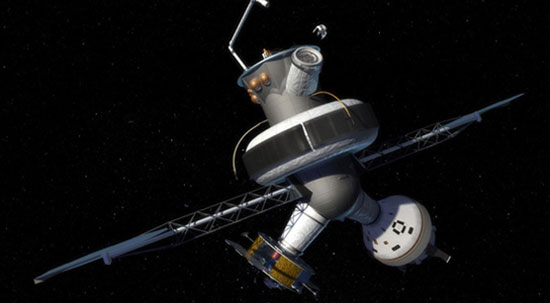
Will NASA’s next space station be beyond the moon?

station_eml2.jpeg

The ISS is pretty cool and all, and it’s got a sweet view of Earth, but you know what? Welive on Earth. Let’s do some exploring! The Orlando Sentinel is reporting that NASA may have its eye on a more exotic location for the successor to the ISS: out beyond the orbit of the Moon, serving as a gateway to Mars and beyond.

The station, which so far exists only as a “leading candidate” for NASA’s next major mission, would be located at the L2 Earth-Moon Lagrange Point (or EML-2), approximately 277,000 miles from Earth, or about 276,800 miles farther from Earth than the ISS is currently. A Lagrange Point is a spot in an orbital system where the gravitational forces of two massive bodies (like the Earth and the Moon) combine to create areas where a much less massive body (like a space station) can park out while not moving relative to the other bodies in the system. There are five of these points, as illustrated below, and once you get to one and stop moving, you can just sit there indefinitely.
via DVICE

Continue reading 

Image: Dan Lester/University of Texas

Leave a Reply

featured blogs
May 6, 2026
Hollywood has struck gold with The Lord of the Rings and Dune'”so which sci-fi and fantasy books should filmmakers tackle next?...

featured paper

Quickly and accurately identify inter-domain leakage issues in IC designs

Sponsored by Siemens Digital Industries Software

Power domain leakage is a major IC reliability issue, often missed by traditional tools. This white paper describes challenges of identifying leakage, types of false results, and presents Siemens EDA’s Insight Analyzer. The tool proactively finds true leakage paths, filters out false positives, and helps circuit designers quickly fix risks—enabling more robust, reliable chip designs. With detailed, context-aware analysis, designers save time and improve silicon quality.

Click to read more

featured chalk talk

What’s Driving Zephyr’s Momentum
In this episode of Chalk Talk, Brendon Slade from NXP and Amelia Dalton explore what Zephyr makes unique, how it compares to other RTOS options, and how its design philosophy enables developers to scale from simple prototypes to production-ready systems with confidence.
May 4, 2026
13,641 views





