

fresh bytes
Subscribe Now

Will NASA’s next space station be beyond the moon?

station_eml2.jpeg

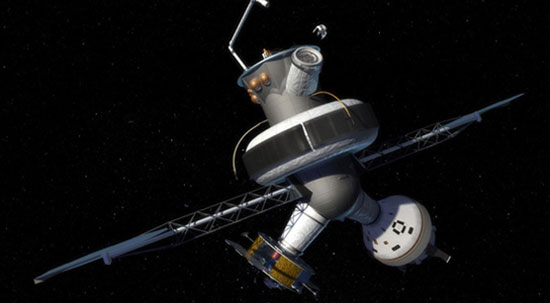
The ISS is pretty cool and all, and it’s got a sweet view of Earth, but you know what? Welive on Earth. Let’s do some exploring! The Orlando Sentinel is reporting that NASA may have its eye on a more exotic location for the successor to the ISS: out beyond the orbit of the Moon, serving as a gateway to Mars and beyond.

The station, which so far exists only as a “leading candidate” for NASA’s next major mission, would be located at the L2 Earth-Moon Lagrange Point (or EML-2), approximately 277,000 miles from Earth, or about 276,800 miles farther from Earth than the ISS is currently. A Lagrange Point is a spot in an orbital system where the gravitational forces of two massive bodies (like the Earth and the Moon) combine to create areas where a much less massive body (like a space station) can park out while not moving relative to the other bodies in the system. There are five of these points, as illustrated below, and once you get to one and stop moving, you can just sit there indefinitely.
via DVICE

Continue reading 

Image: Dan Lester/University of Texas

Leave a Reply

featured blogs
Feb 18, 2026
Because sometimes the best replacement part'¦ is the one you already have!...

featured video

Cadence Chiplets Solutions | Helping you realize your chiplet ambitions

Sponsored by Cadence Design Systems

In this webinar, David Glasco, VP of Compute Solutions at Cadence, discusses how Cadence enables customers to transition from traditional monolithic SoC architectures to modular, scalable chiplet-based solutions, essential for meeting the growing demands of physical AI applications and high-performance computing.

Read eBook: Helping You Realize Your Chiplet Ambitions

featured chalk talk

BMV080: World’s Smallest Particulate Matter (PM) Sensor
In this episode of Chalk Talk, Liaisan Khismatova from Bosch Sensortec and I explore the benefits of the Bosch BMV080, the world’s smallest particulate matter (PM) sensor. They also investigate the fanless innovation at the heart of the BMV080 Particulate Matter Sensor and how the silent and maintenance-free operation and ultra-compact size of this sensor makes it a game changer for next generation air quality monitoring applications. 
Jan 29, 2026
31,229 views




