fresh bytes
Subscribe Now

Was this the world’s first emoticon?

emoticon.jpg

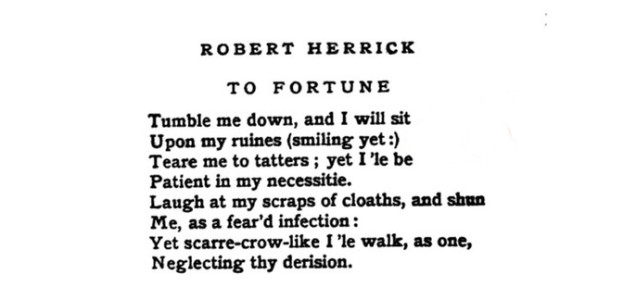
The emoticon might be older than we thought. This passage of text, which includes a cheeky smiley, is taken from Robert Herrick’s 1648 poem To Fortune—and it might be the first ever use of an emoticon.

Literary critic Levi Stahl thought the punctuation might be a typo in his copy of of Hesperides, but he checked out the authoritative two-volume edition of Herrick’s work published last year by the Oxford University Press and found the exact same thing. Stahl has since claimed that that it could well be an intentional invention of the smiley, as the poet’s work is generally cleverly written with smart, underlying humor.
via Gizmodo


Continue reading 

Leave a Reply

featured blogs
Apr 24, 2026
A thought experiment in curiosity, confusion, and cosmic consequences....

featured paper

Want early design analysis without simulation?

Sponsored by Siemens Digital Industries Software

Traditional verification methods are failing today's complex IC designs, which require a proactive, early-stage analysis approach. A shift-left methodology addresses IP block integration challenges and the limitations of traditional simulation and ERC tools. Insight Analyzer detects hard-to-find leakage issues across power domains, enabling early analysis without full simulation. Identify inefficiencies earlier to reduce rework, improve reliability, and enhance power performance.

Click to read more!

featured chalk talk

Analog Output, Isolated Current, & Voltage Sensing Using Isolation Amplifiers
Sponsored by Mouser Electronics and Vishay
In this episode of Chalk Talk, Simon Goodwin from Vishay and Amelia Dalton chat about analog output, and isolated current and voltage sensing using isolation amplifiers. Simon and Amelia also explore the fundamental principles of current and voltage sensing and the variety of voltage and current sensing solutions offered by Vishay that can get your next design up and running in no time.
Apr 27, 2026
2,602 views