fresh bytes
Subscribe Now

Tiny satellites will use Kinect to dock with one another

strand_2.jpg

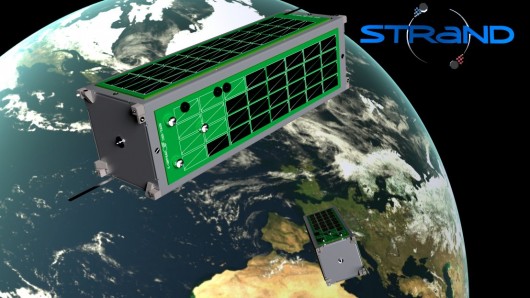
Little satellites grow up to be big satellites. At least, that’s what will happen if Surrey Satellite Technology Limited (SSTL) gets its way. Working in conjunction with the University of Surrey, the UK-based company plans to launch a pair of nano-satellites into orbit equipped with Kinect motion-control sensors that will allow the minisats to seek each other out and dock to form a new, larger satellite. If this technology proves successful, it has the potential to change the way satellites are built, maintained and even disposed of by changing satellites from individual machines into intelligent building blocks.

The new nano-satellite, called STRaND-2, is the latest in SSTL’s STRaND series. Like STRaND-1, STRaND-2 is a three-unit cubesat measuring 30 cm (1 ft) in length. STRaNd-1 managed to pack a lot of functionality into a very small package by using off-the-shelf smartphone technology. STRaND-2 continues this adapt and adopt strategy by using technology from an Xbox Kinect controller for the docking system.
via Gizmag


Continue reading 

Leave a Reply

featured blogs
May 6, 2026
Hollywood has struck gold with The Lord of the Rings and Dune'”so which sci-fi and fantasy books should filmmakers tackle next?...

featured paper

Quickly and accurately identify inter-domain leakage issues in IC designs

Sponsored by Siemens Digital Industries Software

Power domain leakage is a major IC reliability issue, often missed by traditional tools. This white paper describes challenges of identifying leakage, types of false results, and presents Siemens EDA’s Insight Analyzer. The tool proactively finds true leakage paths, filters out false positives, and helps circuit designers quickly fix risks—enabling more robust, reliable chip designs. With detailed, context-aware analysis, designers save time and improve silicon quality.

Click to read more

featured chalk talk

GaN for Humanoid Robots
Sponsored by Mouser Electronics and Infineon
In this episode of Chalk Talk, Eric Persson and Amelia Dalton explore why power is the key driver for efficient and reliable robot movements and how GaN technologies can help motor control solutions be more compact, integrated and efficient. They also investigate the role of field-oriented control in humanoid robotic applications and why the choice of a GaN power transistor can make all the difference in your next humanoid robot project!
Apr 20, 2026
27,907 views