fresh bytes
Subscribe Now

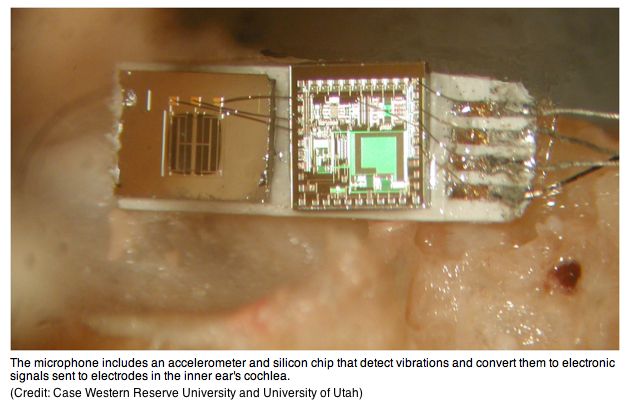
Tiny mic could improve cochlear implants

Screen_Shot_2012-04-30_at_3.38.21_PM.png

Cochlear implants, which help 220,000 deaf people around the world hear, come with a few unfortunate side effects.

Because the implants also consist of external parts (the mic, a speech processor, and a radio transmitter coil) worn rather conspicuously behind the ear, users are often unable to swim or wear helmets comfortably, must fully rely on a microphone exposed to the elements, and have to deal with appearing at least somewhat handicapped.

So an electrical engineer at the University of Utah has developed a prototype that moves all these external parts into the middle ear, allowing cochlear implants to fully live up to their name.
via cnet


Continue reading 

Leave a Reply

featured blogs
May 6, 2026
Hollywood has struck gold with The Lord of the Rings and Dune'”so which sci-fi and fantasy books should filmmakers tackle next?...

featured paper

Quickly and accurately identify inter-domain leakage issues in IC designs

Sponsored by Siemens Digital Industries Software

Power domain leakage is a major IC reliability issue, often missed by traditional tools. This white paper describes challenges of identifying leakage, types of false results, and presents Siemens EDA’s Insight Analyzer. The tool proactively finds true leakage paths, filters out false positives, and helps circuit designers quickly fix risks—enabling more robust, reliable chip designs. With detailed, context-aware analysis, designers save time and improve silicon quality.

Click to read more

featured chalk talk

CBOT MULTIGIG Transceiver Platform
In this episode of Chalk Talk, Anders Thelin from TE Connectivity and Amelia Dalton explore how the CBOT MULTIGIG transceiver platform helps address these challenges with a modular, high-performance approach to rugged, high-density connectivity. We also investigate how this platform supports next-generation system architectures, improves design efficiency, and enables robust performance in even the most demanding environments.
May 18, 2026
920 views