

fresh bytes
Subscribe Now

This tiny, bipedal robot can somersault and run faster than a toddler

achires.jpg

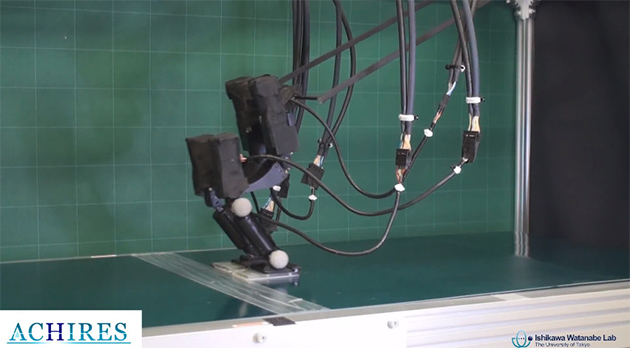
Those of you with recurring Terminator-esque nightmares of a not-so-distant future ruled by machines won’t have to worry much about one robot developed by a research team at the University of Tokyo. The group (which happens to be the same one that created a robot that’ll cheat its way to rock-paper-scissors victory every time) crafted a bipedal ‘bot called Achires that can run at speeds up to 2.6 miles per hour. What makes Achires so special is that it doesn’t actually factor in complex biomechanical factors like the zero moment point. Instead, its creators have a high-speed camera trained on it at all times, and the system uses all that visual data to continually keeps the robot’s running posture stable. The end result? A way to get a robot running that doesn’t require the sheer computational horsepower that some of its other bipedal cousins do.
via Engadget


Continue reading 


Leave a Reply

featured blogs
Apr 24, 2026
A thought experiment in curiosity, confusion, and cosmic consequences....

featured paper

Quickly and accurately identify inter-domain leakage issues in IC designs

Sponsored by Siemens Digital Industries Software

Power domain leakage is a major IC reliability issue, often missed by traditional tools. This white paper describes challenges of identifying leakage, types of false results, and presents Siemens EDA’s Insight Analyzer. The tool proactively finds true leakage paths, filters out false positives, and helps circuit designers quickly fix risks—enabling more robust, reliable chip designs. With detailed, context-aware analysis, designers save time and improve silicon quality.

Click to read more

featured chalk talk

Analog Output, Isolated Current, & Voltage Sensing Using Isolation Amplifiers
Sponsored by Mouser Electronics and Vishay
In this episode of Chalk Talk, Simon Goodwin from Vishay and Amelia Dalton chat about analog output, and isolated current and voltage sensing using isolation amplifiers. Simon and Amelia also explore the fundamental principles of current and voltage sensing and the variety of voltage and current sensing solutions offered by Vishay that can get your next design up and running in no time.
Apr 27, 2026
20 views




