

fresh bytes
Subscribe Now

This mobile dialysis machine will clean your blood on the go

flhxchp8f7n878g7z9tr.jpg

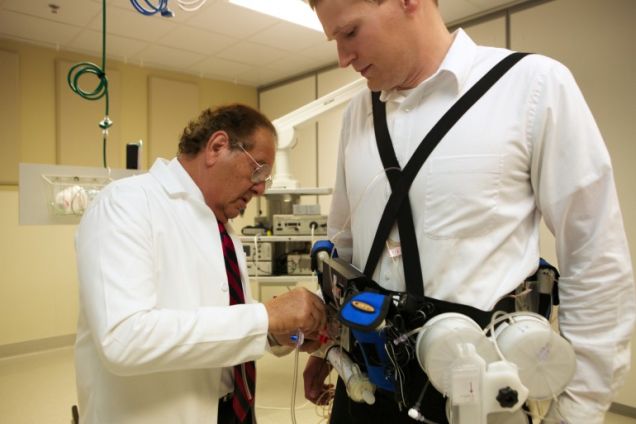
The days of hemodialysis patients spending hours upon hours sitting in a hospital lounge while waiting for their blood to be cleaned could soon be a thing of the past—assuming, of course, that the world’s first wearable artificial kidney passes FDA muster later this year.

Dubbed the Wearable Artificial Kidney (the WAK), this device is the result of more than a decade of development by teams at Cedars-Sinai Medical Center, Los Angeles and the David Geffen School of Medicine at UCLA, led by Victor Gura. It is, quite simply, a miniaturized dialysis machine small enough to wear on a toolbelt, simple enough to port in with a standard catheter, and light enough to wear all day. It works just like a conventional dialysis machine—dirty blood is sucked out of your body, pressed through a series of molecular filters to sieve out the waste, then pumped back in—and on the same schedule as a conventional dialysis machine—3, 4-hour sessions every week—except instead of weighing 200 pounds and resembling a filing cabinet, the WAK weighs 10 pounds and fits around your waist.
via Gizmodo


Continue reading 

Leave a Reply

featured blogs
Apr 24, 2026
A thought experiment in curiosity, confusion, and cosmic consequences....

featured paper

Quickly and accurately identify inter-domain leakage issues in IC designs

Sponsored by Siemens Digital Industries Software

Power domain leakage is a major IC reliability issue, often missed by traditional tools. This white paper describes challenges of identifying leakage, types of false results, and presents Siemens EDA’s Insight Analyzer. The tool proactively finds true leakage paths, filters out false positives, and helps circuit designers quickly fix risks—enabling more robust, reliable chip designs. With detailed, context-aware analysis, designers save time and improve silicon quality.

Click to read more

featured chalk talk

Analog Output, Isolated Current, & Voltage Sensing Using Isolation Amplifiers
Sponsored by Mouser Electronics and Vishay
In this episode of Chalk Talk, Simon Goodwin from Vishay and Amelia Dalton chat about analog output, and isolated current and voltage sensing using isolation amplifiers. Simon and Amelia also explore the fundamental principles of current and voltage sensing and the variety of voltage and current sensing solutions offered by Vishay that can get your next design up and running in no time.
Apr 27, 2026
6 views




