

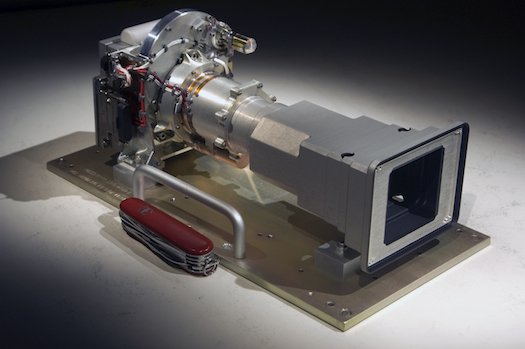
The Mars Science Laboratory (MSL, aka the Curiosity) has two mast cameras, as seen here. One has a fixed 34mm f/8 lens that covers a 15° field of view, covering 1200×1200 pixels on a 1600 by 1200 CCD. The other is a fixed 100mm f/10 lens, with a 5.1° field of view on an identical sensor. You can see some pre-launch images taken with them here.
These cameras won’t start showing their stuff until later this week. They’ll transmit color images as they have Bayer Pattern Filter CCDs, and have adjustable filters to capture different wavelengths of light:
Each Mastcam camera head also has a filter wheel, so that images taken by looking through filters covering different, narrow visible and near-infrared wavelengths can be obtained. Filters for the 34 mm Mastcam are (in nanometers): 440, 525, 550, 675, 750, 865, 1034, and 440(neutral density). Filters for the 100 mm Mastcam are (in nanometers): 440, 525, 550, 800, 905, 935, 1035, and 880(neutral density). The neutral density filters are for viewing the Sun. Each filter wheel also includes a visually clear (actually infrared rejection coated) filter for nominal RGB (red, green, blue) imaging using the Bayer Pattern CCD.
via Pop Photo
Also, this is another good article about Curiosity’s cameras here at Wired:
The Photo-Geek’s Guide to Curiosity Rover’s 17 Cameras






