

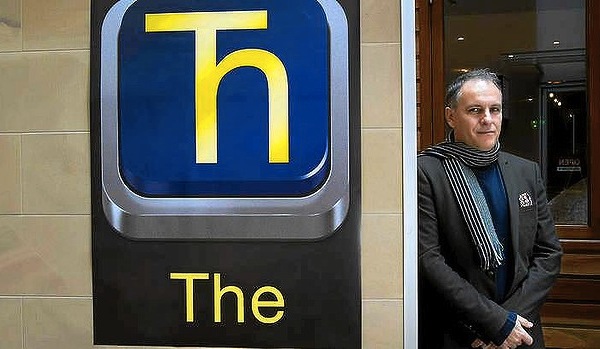
The word “the” is the most commonly-used word of the English language; it makes an appearance in around 80% of all written paragraphs.
To recognize its usage and usefulness, Melbourne-based Australian restaurateur Paul Mathis has created a new symbol as a short-formed substitute for “the”.
The “the” symbol looks like what happens when an uppercase “T” conjoins with a lowercase “h”: ‘?’.
Like an ampersand (&) for “and”, ? hopes to: save “penstrokes”, “keystrokes” and “space”; make tweeting and texting more efficient; and be the “next step in communication evolution”.
via Design Taxi








There really is nothing new! The “thorn” character in Old English, Icelandic, and Old Norse alphabets represented the “th” sound. It looked like this “þ” – a sort of combination b and p and was used in words like seeþ or þerafter (seeth and thereafter).
This seems a little like re-inventing the wheel… It would be nice if people would do a little research into the past before they try and change the future 😉
Well, at least the futhark is represented in Unicode. Why this guy thinks that a new character that doesn’t exist on any system is somehow easier is beyond me… How long will it take for this to be accepted, get a Unicode number, and, most importantly, end up on a keyboard? (Yes, I still believe in keyboards…)
And after all that, we’ll need a different symbol for “teh”.
Wow! He not only create the new letter, but added it to unicode tables and to fonts in my computer!
Wow! And to many old books!!!
See “tshe” Wikipedia article:
http://en.wikipedia.org/wiki/?
“g+1” button present but where is “g-1” button?