

fresh bytes
Subscribe Now

The dangers of a bigger Godzilla

godzilla.jpg

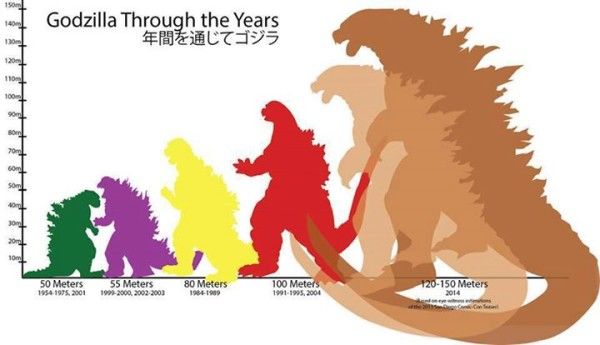
Godzilla has grown larger over the years, as you can see in this graph. In 1954, the movie monster was only 50 meters (164 feet) tall (as if that isn’t tall enough). In the 2014 movie, opening later this month, Godzilla is estimated to be about 150 meters (492 feet) tall! Deep Sea News crunches the numbers to study this size change and speculate on its meaning.

So why is Godzilla obtaining ever larger sizes with time?  Skyscrapers.  Skyscraper height has increased dramatically over the last century.  For Godzilla to continue to plow through buildings in major metropolises, a more formidable size is needed.  Of course this size change can only be evolutionarily adaptive if it changes the fitness of Godzilla, i.e. in the simplest case the number of offspring passed to the next generation.  If Godzilla is able to topple buildings this might allow for greater acquisition of resources in this case food in the form of people. This would increase the lifespan of Godzilla allow for more reproduction or allow for greater amount of energy to be passed to the offspring increasing their rate of survival  Or perhaps toppling buildings is a sexual display that sexual partners cue on.
via Neatorama

Continue reading 

Image:  Deep Sea News

Leave a Reply

featured blogs
Apr 24, 2026
A thought experiment in curiosity, confusion, and cosmic consequences....

featured paper

Quickly and accurately identify inter-domain leakage issues in IC designs

Sponsored by Siemens Digital Industries Software

Power domain leakage is a major IC reliability issue, often missed by traditional tools. This white paper describes challenges of identifying leakage, types of false results, and presents Siemens EDA’s Insight Analyzer. The tool proactively finds true leakage paths, filters out false positives, and helps circuit designers quickly fix risks—enabling more robust, reliable chip designs. With detailed, context-aware analysis, designers save time and improve silicon quality.

Click to read more

featured chalk talk

GaN for Humanoid Robots
Sponsored by Mouser Electronics and Infineon
In this episode of Chalk Talk, Eric Persson and Amelia Dalton explore why power is the key driver for efficient and reliable robot movements and how GaN technologies can help motor control solutions be more compact, integrated and efficient. They also investigate the role of field-oriented control in humanoid robotic applications and why the choice of a GaN power transistor can make all the difference in your next humanoid robot project!
Apr 20, 2026
10,166 views






