

fresh bytes
Subscribe Now

Studying the connected car on two continents

connectedcar.jpeg

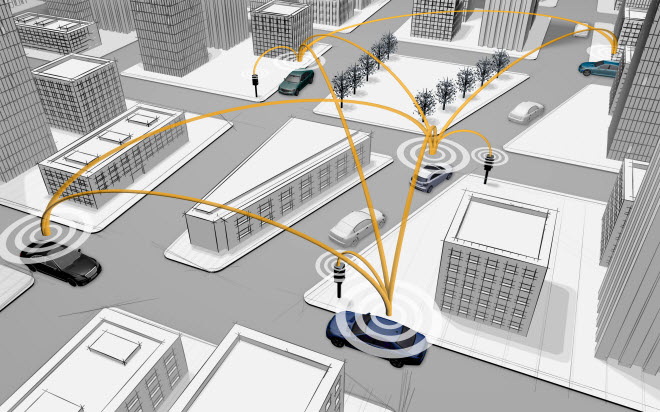
You may talk to your car, and some in cases it may even talk back. And you’ve probably thrown a few choice words at other drivers in a impromptu bout of rage. But cars are silently communicating with each other and with transportation infrastructure in two field trials that kicked off this month near Frankfurt, Germany, and in Ann Arbor, Michigan.

Mercedes-Benz parent company Daimler is spearheading what it’s calling the “first ‘social network’ for automobiles.” But instead of sharing lolcat pics and mundane musings, the 120 vehicles in the project will be communicating with one another as well as with infrastructure to avoid accidents and traffic jams, along with a range of other applications. Daimler claims it’s the largest ever field trial of vehicle-to-X communication (V2X) – a combination of vehicle-to-vehicle (V2V) and vehicle-to-infrastructure (V2I) communication – to show how the technology can be used to decrease accidents and increase driving efficiency. But in sheer number of vehicles it pales in comparison to a similar V2V field trial that the National Transportation Safety Administration (NHTSA) is conducting in Ann Arbor, Michigan.
via Wired/Autopia

Continue reading

Photo: Daimler 

Leave a Reply

featured blogs
May 6, 2026
Hollywood has struck gold with The Lord of the Rings and Dune'”so which sci-fi and fantasy books should filmmakers tackle next?...

featured paper

Quickly and accurately identify inter-domain leakage issues in IC designs

Sponsored by Siemens Digital Industries Software

Power domain leakage is a major IC reliability issue, often missed by traditional tools. This white paper describes challenges of identifying leakage, types of false results, and presents Siemens EDA’s Insight Analyzer. The tool proactively finds true leakage paths, filters out false positives, and helps circuit designers quickly fix risks—enabling more robust, reliable chip designs. With detailed, context-aware analysis, designers save time and improve silicon quality.

Click to read more

featured chalk talk

GaN for Humanoid Robots
Sponsored by Mouser Electronics and Infineon
In this episode of Chalk Talk, Eric Persson and Amelia Dalton explore why power is the key driver for efficient and reliable robot movements and how GaN technologies can help motor control solutions be more compact, integrated and efficient. They also investigate the role of field-oriented control in humanoid robotic applications and why the choice of a GaN power transistor can make all the difference in your next humanoid robot project!
Apr 20, 2026
26,179 views






