fresh bytes
Subscribe Now

Stretchable artificial skin can give prosthetics the sense of touch

artificial-skin.jpg

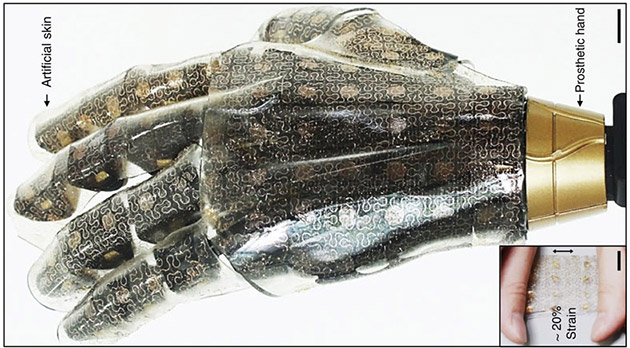
Some prosthetic limbs are so advanced they can be controlled by the brain, but no bionic arm or leg will ever be truly be life-like until they have “skin” that can feel. This new artificial skin developed by a team of American and Korean researchers, for instance, has a dense network of sensors made of silicon and gold that mimic the sensitivity of real skin. The amount of sensors present is important, because as Roozbeh Ghaffari (one of the researchers, who also works for MC10, the same startup behind those Biostamp stickers) said: “If you have these sensors at high resolution across the finger, you can give the same tactile touch that the normal hand would convey to the brain.”

Thus, their creation can detect pressure, heat and cold, and even moisture, as discussed in the team’s paper published on Nature Communications on December 9th.
via Engadget

Continue reading 

Leave a Reply

featured blogs
Apr 24, 2026
A thought experiment in curiosity, confusion, and cosmic consequences....

featured paper

Quickly and accurately identify inter-domain leakage issues in IC designs

Sponsored by Siemens Digital Industries Software

Power domain leakage is a major IC reliability issue, often missed by traditional tools. This white paper describes challenges of identifying leakage, types of false results, and presents Siemens EDA’s Insight Analyzer. The tool proactively finds true leakage paths, filters out false positives, and helps circuit designers quickly fix risks—enabling more robust, reliable chip designs. With detailed, context-aware analysis, designers save time and improve silicon quality.

Click to read more

featured chalk talk

Connecting the World Through Space
Sponsored by Mouser Electronics and Qorvo
In this episode of Chalk Talk, Ryan Jennings from Qorvo and Amelia Dalton explore the critical components and design challenges inherent in LEO satellite infrastructure and how Qorvo’s solutions are enabling the next generation of space-based connectivity. 
Mar 30, 2026
26,184 views