

fresh bytes
Subscribe Now

Sound waves can be used to levitate and move small objects


soundwaves.jpg

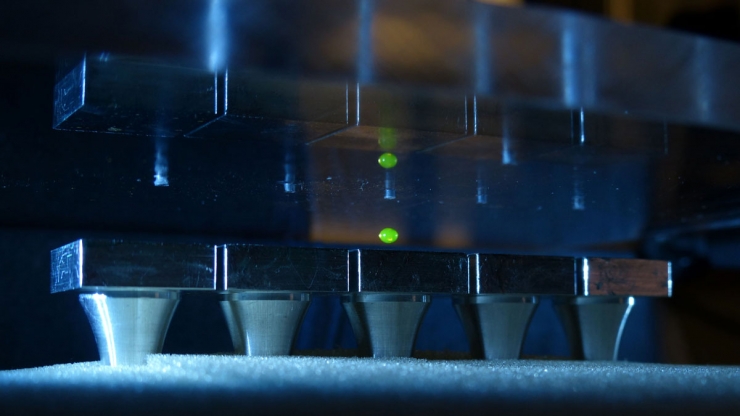
It seems that levitation without contact is no longer just a cool illusion trick performed by magicians. Scientists at the Laboratory of Thermodynamics in Emerging Technologies in Zurich, Switzerland, have successfully levitated small objects using only sound waves.

Acoustic levitation is better than magnetic levitation in that it can be used on any object, not just materials that are magnetic. The only limitation with acoustic levitation is that the object’s diameter must correspond to half the wavelength of the acoustic waves. Although acoustic levitation has been performed before, this new method allows researchers to have full control over an object’s movement with a precision not seen in previous studies. With this new technique, the effect is created by static waves that are held in place by a reflector that bounces the wave back upon itself. This causes interference and creates a consistent upwards pressure that can cancel out the effect of gravity on an object placed within its field.
via DVICE

Continue reading

Image credit: Dimos Poulikakos/ETH Zurich 

Leave a Reply

featured blogs
May 6, 2026
Hollywood has struck gold with The Lord of the Rings and Dune'”so which sci-fi and fantasy books should filmmakers tackle next?...

featured paper

Quickly and accurately identify inter-domain leakage issues in IC designs

Sponsored by Siemens Digital Industries Software

Power domain leakage is a major IC reliability issue, often missed by traditional tools. This white paper describes challenges of identifying leakage, types of false results, and presents Siemens EDA’s Insight Analyzer. The tool proactively finds true leakage paths, filters out false positives, and helps circuit designers quickly fix risks—enabling more robust, reliable chip designs. With detailed, context-aware analysis, designers save time and improve silicon quality.

Click to read more

featured chalk talk

GaN for Humanoid Robots
Sponsored by Mouser Electronics and Infineon
In this episode of Chalk Talk, Eric Persson and Amelia Dalton explore why power is the key driver for efficient and reliable robot movements and how GaN technologies can help motor control solutions be more compact, integrated and efficient. They also investigate the role of field-oriented control in humanoid robotic applications and why the choice of a GaN power transistor can make all the difference in your next humanoid robot project!
Apr 20, 2026
20,280 views





