fresh bytes
Subscribe Now

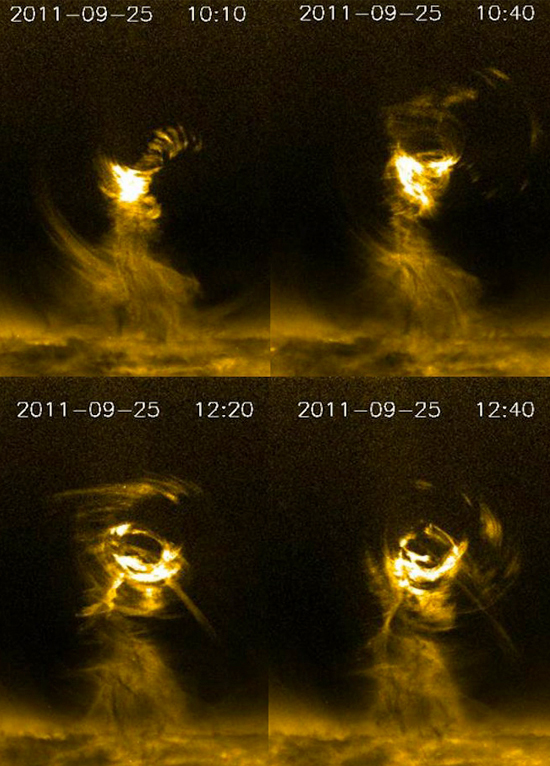
Solar tornado five times the size of the Earth

solarstorm-thumb-550xauto-87455.jpg

It’s five times the size of the Earth! If the size of this solar tornado doesn’t scare the pants off you, the temperature of it should. This solar twister is made from gas ranging from 90,000 to 3.6 million degrees Fahrenheit.

Sure, you saying. It’s the sun — it’s supposed to be hot. Clearly we’re going to have to throw out some more numbers to terrify impress you.

This monster stretched 125,000 miles off the sun’s surface, and the winds were around 186,000 per hour for the three hours it lasted. Not that we don’t fully respect the tornadoes here on Earth, but they only reach speeds of around 100 miles per hour.

Solar tornadoes are often precursors to coronal mass ejections. Like a flare up on a giant barbeque, an enormous eruption of charged particles will burst off the sun’s surface. It’s believed that interactions in the sun’s magnetic field lines cause the twisting movements that escalate into tornadoes and in some cases the coronal mass ejections.
via DVICE

Continue reading (and check out the cool animation) 

Leave a Reply

featured blogs
May 6, 2026
Hollywood has struck gold with The Lord of the Rings and Dune'”so which sci-fi and fantasy books should filmmakers tackle next?...

featured paper

Want early design analysis without simulation?

Sponsored by Siemens Digital Industries Software

Traditional verification methods are failing today's complex IC designs, which require a proactive, early-stage analysis approach. A shift-left methodology addresses IP block integration challenges and the limitations of traditional simulation and ERC tools. Insight Analyzer detects hard-to-find leakage issues across power domains, enabling early analysis without full simulation. Identify inefficiencies earlier to reduce rework, improve reliability, and enhance power performance.

Click to read more!

featured chalk talk

What’s Driving Zephyr’s Momentum
In this episode of Chalk Talk, Brendon Slade from NXP and Amelia Dalton explore what Zephyr makes unique, how it compares to other RTOS options, and how its design philosophy enables developers to scale from simple prototypes to production-ready systems with confidence.
May 4, 2026
18,045 views