fresh bytes
Subscribe Now

Smaller, quicker, secret, robotic: inside America’s new space force

The-first-X-37B-lands-in-California-in-December-2010.-Air-Force-photo..jpg
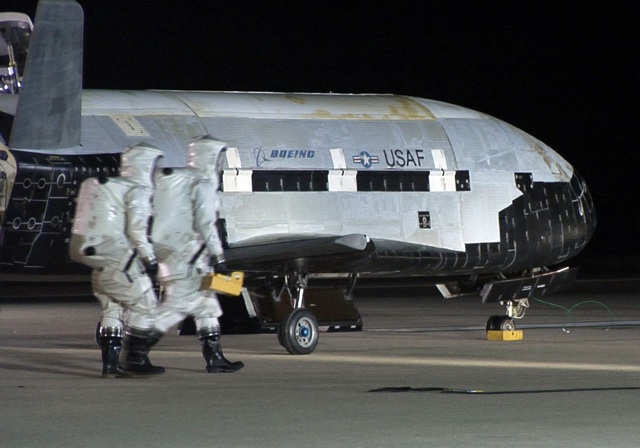
The first X-37B lands in California in December 2010. Photo: Air Force

The past and future of America’s space arsenal intersected, briefly, in the summer of 2011. For two weeks in July, NASA’s Space Shuttle Atlantis roughly shared its Earth orbit with the Air Force’s X-37B, a 29-foot-long, highly maneuverable robotic spacecraft that entered service in early 2010 and has been cloaked in secrecy ever since. The X-37 was around 80 miles higher than the Shuttle, so it’s doubtful the four-person Atlantis crew, conducting the 135th and last Shuttle mission, ever saw the robotic craft. The X-37′s small size — barely a quarter the length of Atlantis — made a sighting even less likely.

Equally striking was the difference in cost between Atlantis and its tiny robotic compatriot. Atlantis costmore than $10 billion to design and build and around $500 million to launch on that one mission. The Boeing-built X-37 mini-shuttle set the taxpayers back an estimated $1 billion for development and construction and just $180 million to send into space. (All cost figures in this story are in today’s dollars.)
via Wired

Continue reading 

Leave a Reply

featured blogs
May 6, 2026
Hollywood has struck gold with The Lord of the Rings and Dune'”so which sci-fi and fantasy books should filmmakers tackle next?...

featured paper

Want early design analysis without simulation?

Sponsored by Siemens Digital Industries Software

Traditional verification methods are failing today's complex IC designs, which require a proactive, early-stage analysis approach. A shift-left methodology addresses IP block integration challenges and the limitations of traditional simulation and ERC tools. Insight Analyzer detects hard-to-find leakage issues across power domains, enabling early analysis without full simulation. Identify inefficiencies earlier to reduce rework, improve reliability, and enhance power performance.

Click to read more!

featured chalk talk

CBOT MULTIGIG Transceiver Platform
In this episode of Chalk Talk, Anders Thelin from TE Connectivity and Amelia Dalton explore how the CBOT MULTIGIG transceiver platform helps address these challenges with a modular, high-performance approach to rugged, high-density connectivity. We also investigate how this platform supports next-generation system architectures, improves design efficiency, and enables robust performance in even the most demanding environments.
May 18, 2026
920 views