fresh bytes
Subscribe Now

See it, touch it, feel it: Team develops invisible 3-D haptic shape

seeittouchit.jpg

Technology has changed rapidly over the last few years with touch feedback, known as haptics, being used in entertainment, rehabilitation and even surgical training. New research, using ultrasound, has developed an invisible 3-D haptic shape that can be seen and felt.         

The research paper, published in the current issue of ACM Transactions on Graphics and which will be presented at this week’s SIGGRAPH Asia 2014 conference [3-6 December], demonstrates how a method has been created to produce 3D shapes that can be felt in mid-air.

The research, led by Dr Ben Long and colleagues Professor Sriram Subramanian, Sue Ann Seah and Tom Carter from the University of Bristol’s Department of Computer Science, could change the way 3D shapes are used. The new technology could enable surgeons to explore a CT scan by enabling them to feel a disease, such as a tumour, using haptic feedback.
via PhysOrg

Continue reading

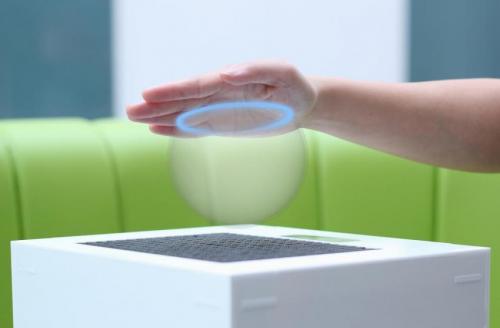
Ultrasound is focused to create the shape of a virtual sphere.
Credit: Bristol Interaction and Graphics group, University of Bristol, copyright © 2014


 

Leave a Reply

featured blogs
Apr 24, 2026
A thought experiment in curiosity, confusion, and cosmic consequences....

featured paper

Quickly and accurately identify inter-domain leakage issues in IC designs

Sponsored by Siemens Digital Industries Software

Power domain leakage is a major IC reliability issue, often missed by traditional tools. This white paper describes challenges of identifying leakage, types of false results, and presents Siemens EDA’s Insight Analyzer. The tool proactively finds true leakage paths, filters out false positives, and helps circuit designers quickly fix risks—enabling more robust, reliable chip designs. With detailed, context-aware analysis, designers save time and improve silicon quality.

Click to read more

featured chalk talk

Connecting the World Through Space
Sponsored by Mouser Electronics and Qorvo
In this episode of Chalk Talk, Ryan Jennings from Qorvo and Amelia Dalton explore the critical components and design challenges inherent in LEO satellite infrastructure and how Qorvo’s solutions are enabling the next generation of space-based connectivity. 
Mar 30, 2026
26,184 views