fresh bytes
Subscribe Now

Scientists use protein to restore hearing to deaf mice

nt3hearing-1.jpg

There may be new hope for people who have lost some of their hearing due to exposure to loud noises, or simply due to aging. Scientists from the University of Michigan and Harvard University have restored hearing in mice, by getting them to create more of a protein within their ears…

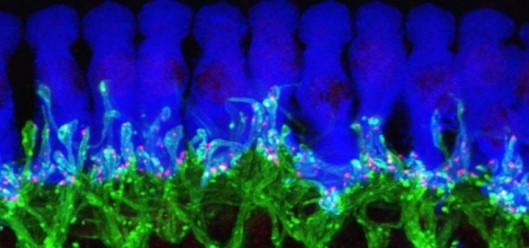
In the Michigan/Harvard research, mice were first subjected to loud noises, causing them to lose some of their hearing via damage to their synapses. A group of those animals was then treated with a technique known as conditional gene recombination, in which drugs are used to activate genes in selected cells. In this case, the cells were in their inner ears, and they were triggered to produce more than the normal amount of NT3 (Neurotrophin-3) – this is a protein which plays a vital role in the production and maintenance of ribbon synapses.

After two weeks, the treated mice were found to have recovered much more of their hearing than an untreated control group.
via Gizmag


Continue reading


Leave a Reply

featured blogs
Apr 24, 2026
A thought experiment in curiosity, confusion, and cosmic consequences....

featured paper

Quickly and accurately identify inter-domain leakage issues in IC designs

Sponsored by Siemens Digital Industries Software

Power domain leakage is a major IC reliability issue, often missed by traditional tools. This white paper describes challenges of identifying leakage, types of false results, and presents Siemens EDA’s Insight Analyzer. The tool proactively finds true leakage paths, filters out false positives, and helps circuit designers quickly fix risks—enabling more robust, reliable chip designs. With detailed, context-aware analysis, designers save time and improve silicon quality.

Click to read more

featured chalk talk

Connecting the World Through Space
Sponsored by Mouser Electronics and Qorvo
In this episode of Chalk Talk, Ryan Jennings from Qorvo and Amelia Dalton explore the critical components and design challenges inherent in LEO satellite infrastructure and how Qorvo’s solutions are enabling the next generation of space-based connectivity. 
Mar 30, 2026
26,937 views