

fresh bytes
Subscribe Now

Scientists build a robot arm that catches objects in the blink of an eye

ultra-fast-bionic-arm.jpg

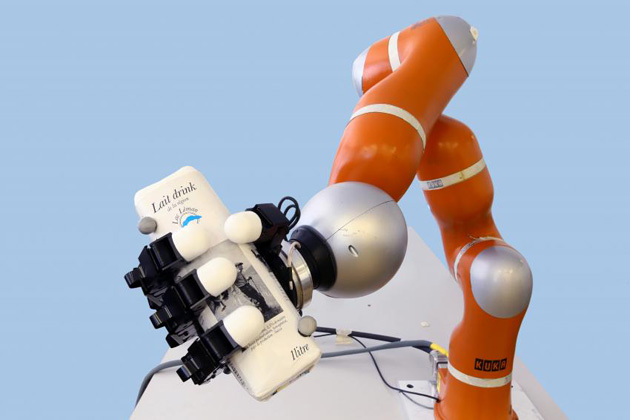
Humans are good at catching fast-moving objects — just ask any baseball fan. Robots typically lag behind, however, which is why the École Polytechnique Fédérale de Lausanne (EPFL) has developed a robot arm with the reaction time needed to catch just about anything. After learning the basic concepts by imitating human behavior, the machine uses its cameras to predict the path of a flying object and grab it in less than five hundredths of a second — roughly as fast as it takes you to blink. It can even adapt to objects whose center of gravity is likely to shift around, such as a half-full drink bottle.
via Engadget


Continue reading 

Leave a Reply

featured blogs
Apr 24, 2026
A thought experiment in curiosity, confusion, and cosmic consequences....

featured paper

Quickly and accurately identify inter-domain leakage issues in IC designs

Sponsored by Siemens Digital Industries Software

Power domain leakage is a major IC reliability issue, often missed by traditional tools. This white paper describes challenges of identifying leakage, types of false results, and presents Siemens EDA’s Insight Analyzer. The tool proactively finds true leakage paths, filters out false positives, and helps circuit designers quickly fix risks—enabling more robust, reliable chip designs. With detailed, context-aware analysis, designers save time and improve silicon quality.

Click to read more

featured chalk talk

Analog Output, Isolated Current, & Voltage Sensing Using Isolation Amplifiers
Sponsored by Mouser Electronics and Vishay
In this episode of Chalk Talk, Simon Goodwin from Vishay and Amelia Dalton chat about analog output, and isolated current and voltage sensing using isolation amplifiers. Simon and Amelia also explore the fundamental principles of current and voltage sensing and the variety of voltage and current sensing solutions offered by Vishay that can get your next design up and running in no time.
Apr 27, 2026
2,383 views




