fresh bytes
Subscribe Now

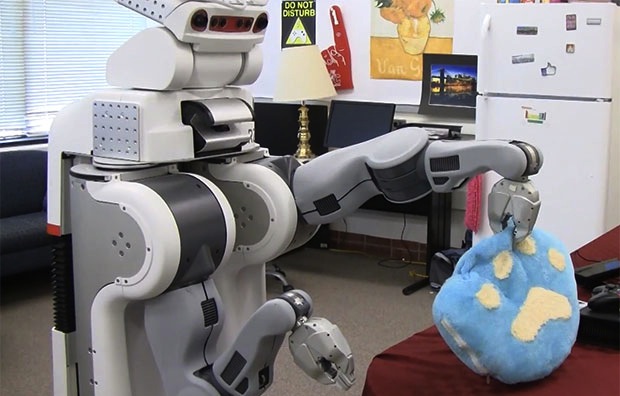
Robots hallucinate humans to aid in object recognition (video)

robothallucinate.jpg

Almost exactly a year ago, we posted about how Ashutosh Saxena’s lab at Cornell was teaching robots to use their “imaginations” to try to picture how a human would want a room organized. The research was successful, with algorithms that used hallucinated humans (which are the best sort of humans) to influence the placement of objects performing significantly better than other methods. Cool stuff indeed, and now comes the next step: labeling 3D point-clouds obtained from RGB-D sensors by leveraging contextual hallucinated people.

A significant amount of research has been done investigating the relationships between objects and other objects. It’s called semantic mapping, and it’s very valuable in giving robots what we’d call things like “intuition” or “common sense.” However, being humans, we tend to live human-centered lives, and that means that the majority of our stuff tends to be human-centered too, and keeping this in mind can help to put objects in context.
via IEEE Spectrum


Continue reading 

Leave a Reply

featured blogs
May 6, 2026
Hollywood has struck gold with The Lord of the Rings and Dune'”so which sci-fi and fantasy books should filmmakers tackle next?...

featured paper

Quickly and accurately identify inter-domain leakage issues in IC designs

Sponsored by Siemens Digital Industries Software

Power domain leakage is a major IC reliability issue, often missed by traditional tools. This white paper describes challenges of identifying leakage, types of false results, and presents Siemens EDA’s Insight Analyzer. The tool proactively finds true leakage paths, filters out false positives, and helps circuit designers quickly fix risks—enabling more robust, reliable chip designs. With detailed, context-aware analysis, designers save time and improve silicon quality.

Click to read more

featured chalk talk

What’s Driving Zephyr’s Momentum
In this episode of Chalk Talk, Brendon Slade from NXP and Amelia Dalton explore what Zephyr makes unique, how it compares to other RTOS options, and how its design philosophy enables developers to scale from simple prototypes to production-ready systems with confidence.
May 4, 2026
9,573 views