

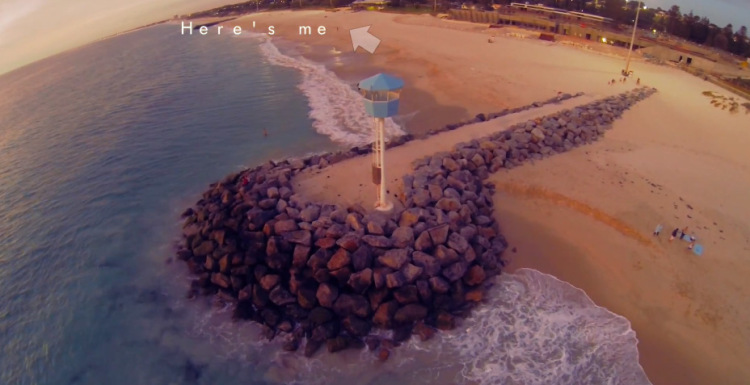
Perth, Australia-based photographer Ryan Chatfield was recording aerial footage of Perth’s City Beach when his brand-new camera drone ran low on batteries and began an automatic descent toward the waves below. What followed was a mad 100-yard dash that required Chatfield to clamber over a rock jetty and into the ocean. He managed to catch the drone when it was about a foot from the water. Then he endured a good flogging by a wave as he climbed back up the jetty with his (intact) drone. All of this was recorded by the drone’s camera.
via Laughing Squid
Image: Ryan Chatfield








What do you guys think about this one – legit, or staged?
I’m unsure. Some things make me suspect it could be staged:
– The camera is conveniently pointed at the guy the whole time. That would make it much easier if someone else were flying it to have it arrive at exactly the right time for him to catch it.
– He arrives without his radio gear – did he just dump it in the sand on the beach and start running?
– He seemed VERY fast to diagnose what was happening (low voltage auto-land) and make the decision to run to try and catch it. He also seemed to take pretty much the optimal path over the jetty to get there – and it would have been a tiny dot in the sky from where he was originally standing.
– The camera is manually tilted back up to “level” after the descent starts. Who did that and why? It did make for a better viewing angle for the rescue.
– The first time we see the props, they have stopped. It’s unclear when/why they would have stopped after he caught it. We don’t see him disconnect the power, and on the audio we hear the waves crashing and him talking, but never the sound of the motors.
– He conveniently keeps the camera pointed at himself while he climbs back up out of the water – and keeps it level.
…lots of very convenient elements.
On the other hand, the whole thing is plausible:
– the DJI flight controllers DO have a low-voltage mode that causes them to descend and auto land if the battery gets too low.
– the quad doesn’t yaw after it starts down (correct for auto-land)
– the descent seems very steady (also correct for auto-land).
Anybody else got any insights?