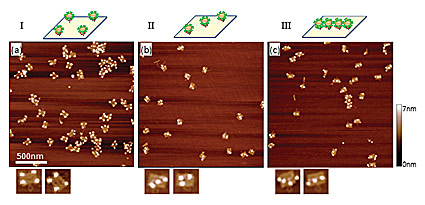
DNA origami: NIST researchers made three DNA origami templates designed so that quantum dots would arrange themselves: (a in the corners, b) diagonally (three dots), and (c in a line (four dots). The researchers found that putting the quantum dots closer together caused them to interfere with one another, leading to higher error rates and lower bonding strength.
In recent years, scientists have begun to harness DNA’s powerful molecular machinery to build artificial structures at the nanoscale using the natural ability of pairs of DNA molecules to assemble into complex structures. Such “DNA origami,” first developed at the California Institute of Technology,* could provide a means of assembling complex nanostructures such as semiconductor devices, sensors and drug delivery systems, from the bottom up.
While most researchers in the field are working to demonstrate what’s possible, scientists at the National Institute of Standards and Technology (NIST) are seeking to determine what’s practical.**
According to NIST researcher Alex Liddle, it’s a lot like building with LEGOs—some patterns enable the blocks to fit together snugly and stick together strongly and some don’t.
“If the technology is actually going to be useful, you have to figure out how well it works,” says Liddle. “We have determined what a number of the critical factors are for the specific case of assembling nanostructures using a DNA-origami template and have shown how proper design of the desired nanostructures is essential to achieving good yield, moving, we hope, the technology a step forward.”
via Center for Nanoscale Science and Technology
Image Credit: Ko/NIST