fresh bytes
Subscribe Now

NASA says: Please don’t touch our stuff when you go to the Moon

Screen_Shot_2012-05-25_at_10.02.13_AM.png

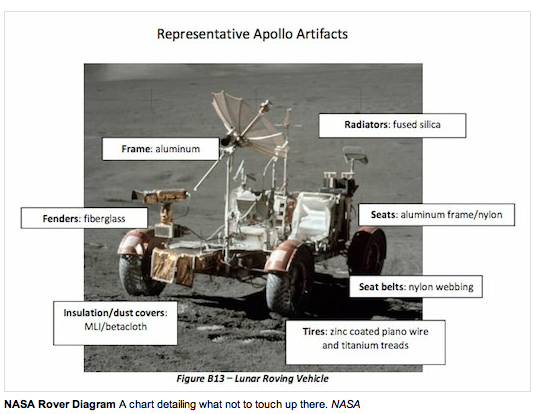
Dear intrepid lunar explorers: NASA politely asks that, when you travel to the moon, you refrain from messing with the American flag.

Google’s Lunar X Prize promises $20 million to whoever’s first to get a privately funded robot to the moon. But the folks at NASA don’t want any of the stuff they left up there getting messed up in the process, so they’ve offered a few handy guidelines for what to stay away from while you’re up there. (We’re looking at you, non-autonomous moon robots.)

The 93-page document, originally released in July but reasserted yesterday, reads like a user’s manual for private space shuttles, and contains a spectacular amount of both tech-talk and legalese.

But it boils down to: “Don’t land in our craters and we won’t land in yours; mostly don’t land in ours.”
via Popular Science


Continue reading 

Leave a Reply

featured blogs
May 6, 2026
Hollywood has struck gold with The Lord of the Rings and Dune'”so which sci-fi and fantasy books should filmmakers tackle next?...

featured paper

Want early design analysis without simulation?

Sponsored by Siemens Digital Industries Software

Traditional verification methods are failing today's complex IC designs, which require a proactive, early-stage analysis approach. A shift-left methodology addresses IP block integration challenges and the limitations of traditional simulation and ERC tools. Insight Analyzer detects hard-to-find leakage issues across power domains, enabling early analysis without full simulation. Identify inefficiencies earlier to reduce rework, improve reliability, and enhance power performance.

Click to read more!

featured chalk talk

GaN for Humanoid Robots
Sponsored by Mouser Electronics and Infineon
In this episode of Chalk Talk, Eric Persson and Amelia Dalton explore why power is the key driver for efficient and reliable robot movements and how GaN technologies can help motor control solutions be more compact, integrated and efficient. They also investigate the role of field-oriented control in humanoid robotic applications and why the choice of a GaN power transistor can make all the difference in your next humanoid robot project!
Apr 20, 2026
27,907 views