fresh bytes
Subscribe Now

NASA funds electricity-harvesting robotic space eel with explosive jet thrusters and electroluminescent skin

eel_rover-1431328878876.jpg

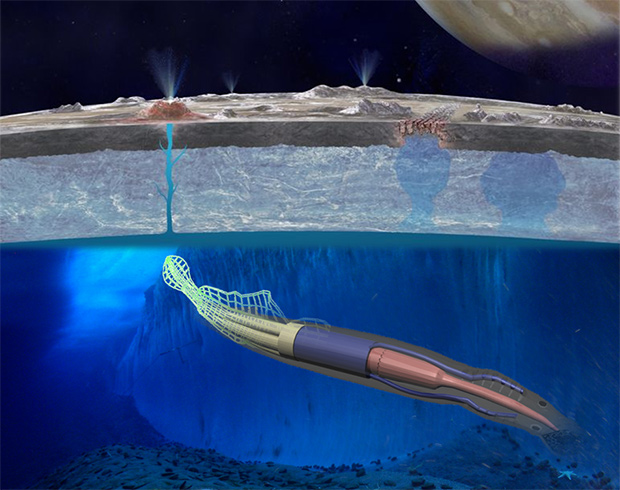
Sometimes, headlines just write themselves. And in this particular case, there’s so much cool stuff going on with this NASA-funded robotic project that we couldn’t even stuff it all in to a single line. It’s a concept for a soft robotic eel designed to explore the oceans of Europa (a moon of Jupiter), which is able to scavenge electrical energy from magnetic fields, use it to generate oxygen and hydrogen, and then light it off to create an explosion to propel itself. Oh, and it’ll have a soft flexible skin that doubles as “a stretchable, electroluminescent display,” because it’s awesome. And why not.

This concept for a “soft-robotic rover with electrodynamic power scavenging” comes from Cornell University, and NASA has awarded it a grant under the NASA Innovative Advanced Concepts (NIAC) program to hoist itself up from TRL 1 to TRL 2. TRLs are “tech readiness levels;” TRL 1 is “basic principles observed and reported” while TRL 2 is “technology concept and/or application formulated.” An actual mission to Europa would involve a system that’s waaay up at TRL 9, so we’ve got a ways to go, but the sheer distance from any sort of practical technological readiness sure does let this robotic eel get away with all kinds of craziness.
via IEEE Spectrum

Continue reading

Image: NASA/Cornell University/NSF

Leave a Reply

featured blogs
Apr 2, 2026
Build, code, and explore with your own AI-powered Mars rover kit, inspired by NASA's Perseverance mission....

featured paper

Quickly and accurately identify inter-domain leakage issues in IC designs

Sponsored by Siemens Digital Industries Software

Power domain leakage is a major IC reliability issue, often missed by traditional tools. This white paper describes challenges of identifying leakage, types of false results, and presents Siemens EDA’s Insight Analyzer. The tool proactively finds true leakage paths, filters out false positives, and helps circuit designers quickly fix risks—enabling more robust, reliable chip designs. With detailed, context-aware analysis, designers save time and improve silicon quality.

Click to read more

featured chalk talk

Connecting the World Through Space
Sponsored by Mouser Electronics and Qorvo
In this episode of Chalk Talk, Ryan Jennings from Qorvo and Amelia Dalton explore the critical components and design challenges inherent in LEO satellite infrastructure and how Qorvo’s solutions are enabling the next generation of space-based connectivity. 
Mar 30, 2026
22,908 views