

One of the main reasons that solar cells aren’t more efficient at converting sunlight into electricity is because much of that sunlight is reflected off the cell, or can’t be fully absorbed by it. A new sandwich-like material created by researchers at Princeton University, however, is claimed to dramatically address that problem – by minimizing reflection and increasing absorption, it reportedly boosts the efficiency of organic solar cells by 175 percent.
Developed by a team led by electrical engineer Prof. Stephen Chou, the material is known as a “plasmonic cavity with subwavelength hole array” or PlaCSH.
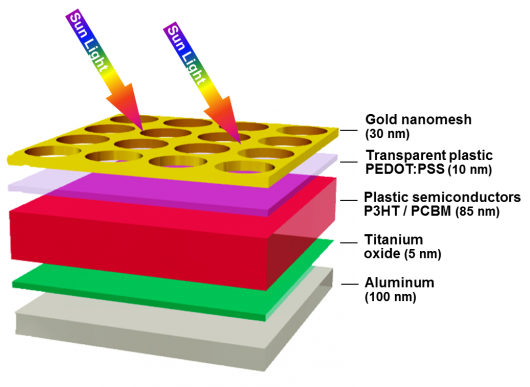
It consists of five very thin layers. On top is the “window layer” through which the sunlight first passes. It’s made from an extremely fine metal mesh, the diameter and spacing of its holes being measured in nanometers. Next is a layer of transparent plastic, followed by a layer of semiconductive material – although Chou used a plastic semiconductor, other materials could be used. This is followed by a layer of titanium oxide, with a layer of aluminum sitting at the bottom of the stack.
via gizmag






