fresh bytes
Subscribe Now

London designer creates 3D-printed, regenerative running shoes from protocells

Screen_Shot_2013-12-11_at_10.45.20_PM.png

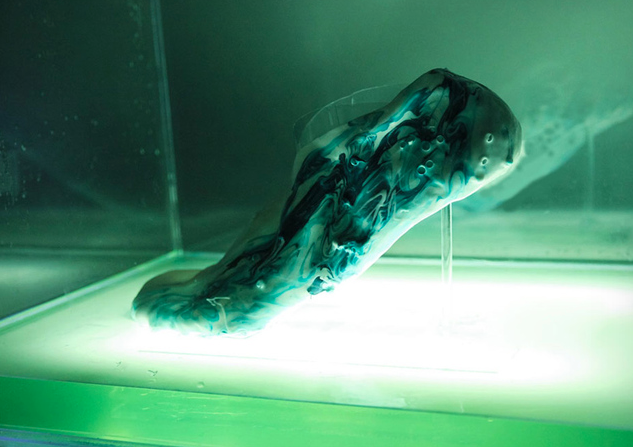
At the Wearable Futures conference, London designer and researcher Shamees Aden debuted a running shoe prototype that will put your worn out kicks to shame. The shoes, which he developed with University of Southern Denmark professor Martin Hanczyc, are 3D printed from a synthetic biological material that can repair itself overnight.

The running shoes are the product of Aden’s study of protocells. The basic protocell molecules are not themselves alive, but can be combined to create living organisms. Mixing different protocells creates different properties, and allows them to be programmed to behave differently depending on heat, light, and pressure. The shoes’ unique construction allows them to be 3D printed to the exact size of the user’s foot, so they would fit like a second skin. While running, the shoes would react to pressure and movement, providing extra cushioning when needed.
via The Verge


Continue reading


Leave a Reply

featured blogs
Apr 24, 2026
A thought experiment in curiosity, confusion, and cosmic consequences....

featured paper

Quickly and accurately identify inter-domain leakage issues in IC designs

Sponsored by Siemens Digital Industries Software

Power domain leakage is a major IC reliability issue, often missed by traditional tools. This white paper describes challenges of identifying leakage, types of false results, and presents Siemens EDA’s Insight Analyzer. The tool proactively finds true leakage paths, filters out false positives, and helps circuit designers quickly fix risks—enabling more robust, reliable chip designs. With detailed, context-aware analysis, designers save time and improve silicon quality.

Click to read more

featured chalk talk

GaN for Humanoid Robots
Sponsored by Mouser Electronics and Infineon
In this episode of Chalk Talk, Eric Persson and Amelia Dalton explore why power is the key driver for efficient and reliable robot movements and how GaN technologies can help motor control solutions be more compact, integrated and efficient. They also investigate the role of field-oriented control in humanoid robotic applications and why the choice of a GaN power transistor can make all the difference in your next humanoid robot project!
Apr 20, 2026
14,792 views