

fresh bytes
Subscribe Now

Lab mice fear men but not women, and that’s a big problem for science

Screen_Shot_2014-04-28_at_9.46.29_PM.png

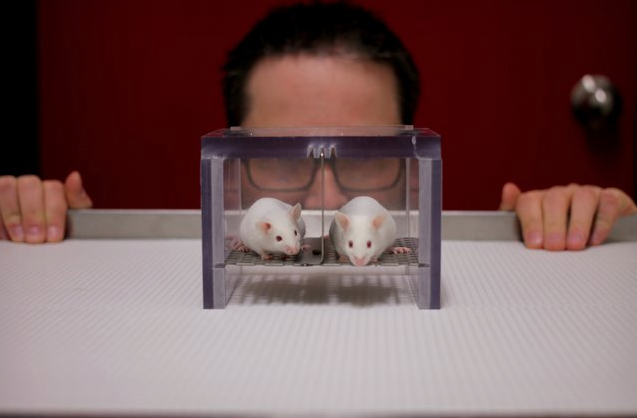
The history of science is one chock-full of mice and men. Historically, biological and medical research has largely depended on rodents, which provide scientists with everything from cells and organs to behavioral data. That’s why a new study in which researchers found that mice actually fear men, but not women, has the potential to be so disruptive. It might mean that a number of researchers have published mouse studies in which their results reflect this male-induced stress effect — and they know nothing about it.

“People have not paid attention to this in the entire history of scientific research of animals,” says Jeffrey Mogil, a pain researcher at McGill University and lead author of the study. “I think that it may have confounded, to whatever degree, some very large subset of existing research.” Moreover, the effect probably isn’t limited to behavioral studies, because the organs and cells that are used in medical research, such as in cancer studies, often originate in rodents. “If you’re doing a liver cell study, the cells came from a rat that was sacrificed either by a man or a woman,” Mogil says. As a result, “its stress levels would be in very different states.” This, he says, could have an effect on the functioning of the liver cell in that later experiment.
via The Verge

Continue reading 

Image: Alexander H. Tuttle

Leave a Reply

featured blogs
Apr 24, 2026
A thought experiment in curiosity, confusion, and cosmic consequences....

featured paper

Quickly and accurately identify inter-domain leakage issues in IC designs

Sponsored by Siemens Digital Industries Software

Power domain leakage is a major IC reliability issue, often missed by traditional tools. This white paper describes challenges of identifying leakage, types of false results, and presents Siemens EDA’s Insight Analyzer. The tool proactively finds true leakage paths, filters out false positives, and helps circuit designers quickly fix risks—enabling more robust, reliable chip designs. With detailed, context-aware analysis, designers save time and improve silicon quality.

Click to read more

featured chalk talk

GaN for Humanoid Robots
Sponsored by Mouser Electronics and Infineon
In this episode of Chalk Talk, Eric Persson and Amelia Dalton explore why power is the key driver for efficient and reliable robot movements and how GaN technologies can help motor control solutions be more compact, integrated and efficient. They also investigate the role of field-oriented control in humanoid robotic applications and why the choice of a GaN power transistor can make all the difference in your next humanoid robot project!
Apr 20, 2026
10,166 views






