fresh bytes
Subscribe Now

Lab gets funding to put 3D goggles on praying mantises

mantis.jpg

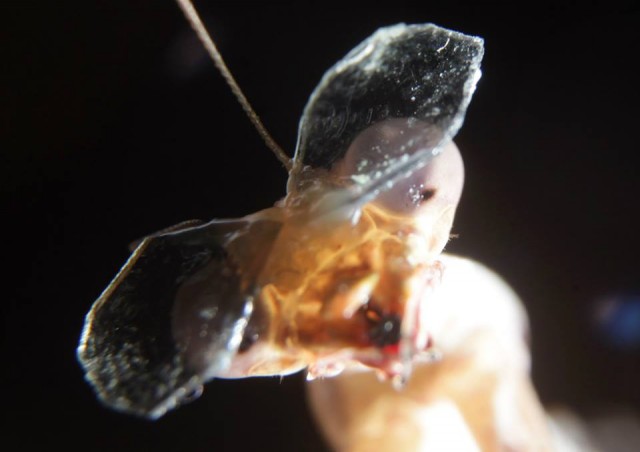
Praying mantises aren’t just unusually large insects; they’re extremely efficient predators that have even been known to catch and eat birds. This requires both a lightning-quick strike and the visual acuity to direct the strike towards the prey. Researchers at Newcastle University, led by Jennifer Read, want to test out the limits of the mantis’ vision. To do that, they’ll try to determine how the animals reconstruct a 3D scene…

[T]hat involves placing a mantis (glued to a stick so it doesn’t move around) in front of a television monitor and filming its strikes. But the lab is now attaching the world’s smallest 3D goggles to a mantis and attempting to manipulate the 3D scene by sending each of its eyes slightly different images. It may turn out that the insect’s brain operates much like a vertebrate’s, using the physical separation of the eyes and the difference in perspective it involves to figure out locations in 3D. If so, it would indicate that the amount of neural horsepower needed to do so is much more limited than we might have thought.
via Ars Technica

Continue reading

Image: Newcastle University

Leave a Reply

featured blogs
Apr 24, 2026
A thought experiment in curiosity, confusion, and cosmic consequences....

featured paper

Quickly and accurately identify inter-domain leakage issues in IC designs

Sponsored by Siemens Digital Industries Software

Power domain leakage is a major IC reliability issue, often missed by traditional tools. This white paper describes challenges of identifying leakage, types of false results, and presents Siemens EDA’s Insight Analyzer. The tool proactively finds true leakage paths, filters out false positives, and helps circuit designers quickly fix risks—enabling more robust, reliable chip designs. With detailed, context-aware analysis, designers save time and improve silicon quality.

Click to read more

featured chalk talk

Analog Output, Isolated Current, & Voltage Sensing Using Isolation Amplifiers
Sponsored by Mouser Electronics and Vishay
In this episode of Chalk Talk, Simon Goodwin from Vishay and Amelia Dalton chat about analog output, and isolated current and voltage sensing using isolation amplifiers. Simon and Amelia also explore the fundamental principles of current and voltage sensing and the variety of voltage and current sensing solutions offered by Vishay that can get your next design up and running in no time.
Apr 27, 2026
2,383 views