

fresh bytes
Subscribe Now

How the chess set got its look and feel

staunton-chess-set-1.jpg

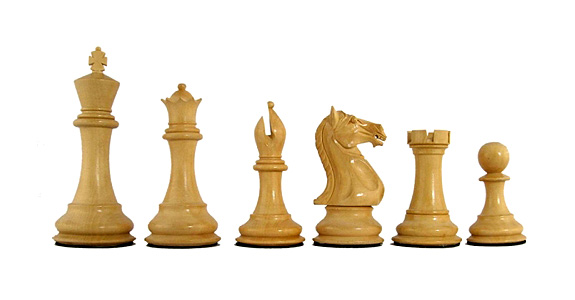
Prior to 1849, there was no such thing as a “normal chess set.” At least not like we think of it today. Over the centuries that chess had been played, innumerable varieties of sets of pieces were created, with regional differences in designation and appearance. As the game proliferated throughout southern Europe in the early 11th century, the rules began to evolve, the movement of the pieces were formalized, and the pieces themselves were drastically transformed from their origins in 6th century India. Originally conceived of as a field of battle, the symbolic meaning of the game changed as it gained popularity in Europe, and the pieces became stand-ins for a royal court instead of an army. Thus, the original chessmen, known as counselor, infantry, cavalry, elephants, and chariots, became the queen, pawn, knight, bishop, and rook, respectively. By the 19th century, chess clubs and competitions began to appear all around the world, it became necessary to use a standardized set that would enable players from different cultures to compete without getting confused.

In 1849, that challenge would be met by the “Staunton” Chess Set.
via Smithsonian

Continue reading 

Leave a Reply

featured blogs
Feb 24, 2026
How a perfectly good Bosch HVAC system was undermined by preventable mistakes, and a thermostat interface that defies logic....

featured video

Cadence Chiplets Solutions | Helping you realize your chiplet ambitions

Sponsored by Cadence Design Systems

In this webinar, David Glasco, VP of Compute Solutions at Cadence, discusses how Cadence enables customers to transition from traditional monolithic SoC architectures to modular, scalable chiplet-based solutions, essential for meeting the growing demands of physical AI applications and high-performance computing.

Read eBook: Helping You Realize Your Chiplet Ambitions

featured chalk talk

Global Coverage With NTN
In this episode of Chalk Talk, Paul Fadlovich from TE Connectivity and Martin Lesund from Nordic Semiconductor and Amelia Dalton explore the what, why and how of NTN technology. They also explore the role that antennas play in satellite communication systems, and how Nordic Semiconductor’s nRF9151 System-in-Package and TE Connectivity’s broad range of antenna solutions can jump start your next global IoT design.
Feb 19, 2026
6,802 views




