

fresh bytes
Subscribe Now

How Ross Perot saved the world’s first electronic computer

computer.jpg

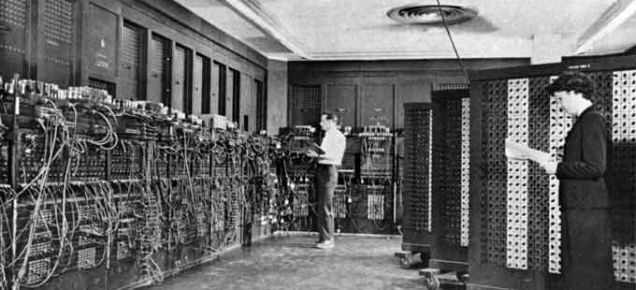
Ross Perot is a collector. He once bought a copy of the Magna Carta in 1984. But more intriguingly, he also bought and resurrected ENIAC, the world’s first electronic computer.

ENIAC stands for the “Electronic Numerical Integrator And Computer” and was conceived of during World War II as a way for artillerymen to calculate the trajectory of bullets. It is an absolutely massive machine weighing in at 27 tons and occupying 1,800 square feet when fully assembled. Construction began in 1943, but by the time it was finished in 1945, the war was over. The Army kept a tight lid on things at first. Even the maintenance manual (below) remained classified until 1946. So what did the United States Army do with this marvel of technology? They used it to design the first hydrogen bomb. Then, in 1955, they threw the thing away.
via Gizmodo


Continue reading 

Leave a Reply

featured blogs
Apr 24, 2026
A thought experiment in curiosity, confusion, and cosmic consequences....

featured paper

Quickly and accurately identify inter-domain leakage issues in IC designs

Sponsored by Siemens Digital Industries Software

Power domain leakage is a major IC reliability issue, often missed by traditional tools. This white paper describes challenges of identifying leakage, types of false results, and presents Siemens EDA’s Insight Analyzer. The tool proactively finds true leakage paths, filters out false positives, and helps circuit designers quickly fix risks—enabling more robust, reliable chip designs. With detailed, context-aware analysis, designers save time and improve silicon quality.

Click to read more

featured chalk talk

Connecting the World Through Space
Sponsored by Mouser Electronics and Qorvo
In this episode of Chalk Talk, Ryan Jennings from Qorvo and Amelia Dalton explore the critical components and design challenges inherent in LEO satellite infrastructure and how Qorvo’s solutions are enabling the next generation of space-based connectivity. 
Mar 30, 2026
26,184 views




