

fresh bytes
Subscribe Now

Future phones could house a terabyte of memory

rice-rram.jpg

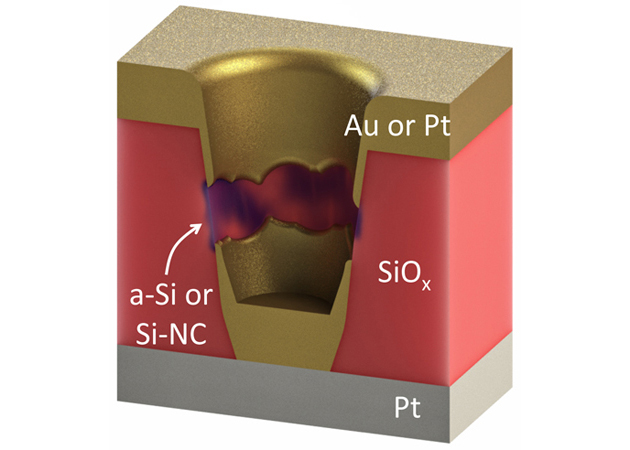
You may think that the 3GB of memory in your new smartphone is hot stuff, but that pales in comparison with what Rice University has in store. Its scientists have detailed a form ofresistive RAM (RRAM) that can be made using regular equipment at room temperatures, making it practical for everyday gadgets. The trick is the use of porous silicon oxide where metals (such as gold or platinum) fill the gaps. Using the silicon material doesn’t just give manufacturers something familiar to work with; it requires much less power than previous techniques, can last through 100 times as many uses and isn’t fazed by heat. It’s also far denser than earlier RRAM, storing nine bits per cell where even conventional flash storage stops at three. The result should be an easy-to-make RAM chip with the kind of capacity that you’d normally expect from much larger permanent storage, like an SSD — as the company Crossbar hinted when it first discussed this approach, you could stuff 1TB into a component the size of a postage stamp.
via Engadget


Continue reading 

Leave a Reply

featured blogs
Apr 24, 2026
A thought experiment in curiosity, confusion, and cosmic consequences....

featured paper

Quickly and accurately identify inter-domain leakage issues in IC designs

Sponsored by Siemens Digital Industries Software

Power domain leakage is a major IC reliability issue, often missed by traditional tools. This white paper describes challenges of identifying leakage, types of false results, and presents Siemens EDA’s Insight Analyzer. The tool proactively finds true leakage paths, filters out false positives, and helps circuit designers quickly fix risks—enabling more robust, reliable chip designs. With detailed, context-aware analysis, designers save time and improve silicon quality.

Click to read more

featured chalk talk

Analog Output, Isolated Current, & Voltage Sensing Using Isolation Amplifiers
Sponsored by Mouser Electronics and Vishay
In this episode of Chalk Talk, Simon Goodwin from Vishay and Amelia Dalton chat about analog output, and isolated current and voltage sensing using isolation amplifiers. Simon and Amelia also explore the fundamental principles of current and voltage sensing and the variety of voltage and current sensing solutions offered by Vishay that can get your next design up and running in no time.
Apr 27, 2026
33 views




