fresh bytes
Subscribe Now

Fermilab experiment will attempt to answer whether we actually live in “the Matrix”

fermi_holometer.jpg

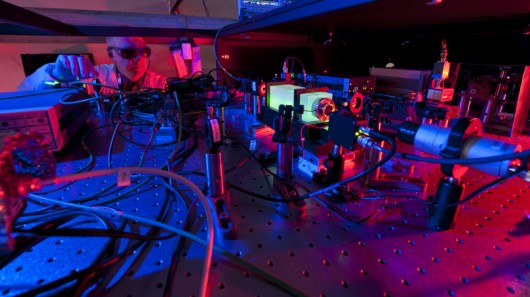
In what may be one of the most mind-bogglingly surreal experiments ever floated, scientists at the US Department of Energy’s Fermi National Accelerator Laboratory (Fermilab) will attempt to discover if the universe is “real” or merely a holographic 3-D illusion that we just think is real. Using high-powered lasers, the scientists intend to determine if space-time is a quantum system made up of countless tiny bits of information.

In explaining their theory, the scientists involved make much of the analogy that, if you stand near enough to a TV screen, you will be able to see the individual pixels that, as you move away, image resolves into a whole image with the individual pixels no longer distinguishable as separate points of light.

So, the scientists propose that if the characters displayed on a TV screen don’t know that their apparent 3-D world exists only on a 2-D screen, we too could also be ignorant to the possibility that our 3-D space is also just an illusion. As such, the Fermilab scientists believe that the information about everything contained in our universe may somehow be embedded in tiny packets of information in two dimensions.
via Gizmag

Continue reading

Image: Fermilab 


One thought on “Fermilab experiment will attempt to answer whether we actually live in “the Matrix””

  1. I believe that since most things break down into quanta,there is a definite granularity, so thus a design, and hence hologram-like for a better word. -Lee Studley

Leave a Reply

featured blogs
Apr 24, 2026
A thought experiment in curiosity, confusion, and cosmic consequences....

featured paper

Quickly and accurately identify inter-domain leakage issues in IC designs

Sponsored by Siemens Digital Industries Software

Power domain leakage is a major IC reliability issue, often missed by traditional tools. This white paper describes challenges of identifying leakage, types of false results, and presents Siemens EDA’s Insight Analyzer. The tool proactively finds true leakage paths, filters out false positives, and helps circuit designers quickly fix risks—enabling more robust, reliable chip designs. With detailed, context-aware analysis, designers save time and improve silicon quality.

Click to read more

featured chalk talk

Connecting the World Through Space
Sponsored by Mouser Electronics and Qorvo
In this episode of Chalk Talk, Ryan Jennings from Qorvo and Amelia Dalton explore the critical components and design challenges inherent in LEO satellite infrastructure and how Qorvo’s solutions are enabling the next generation of space-based connectivity. 
Mar 30, 2026
28,010 views