fresh bytes
Subscribe Now

Electronic skin could give prostheses and robots a sense of touch

artificial-skin-mechanoreceptors-1.jpg

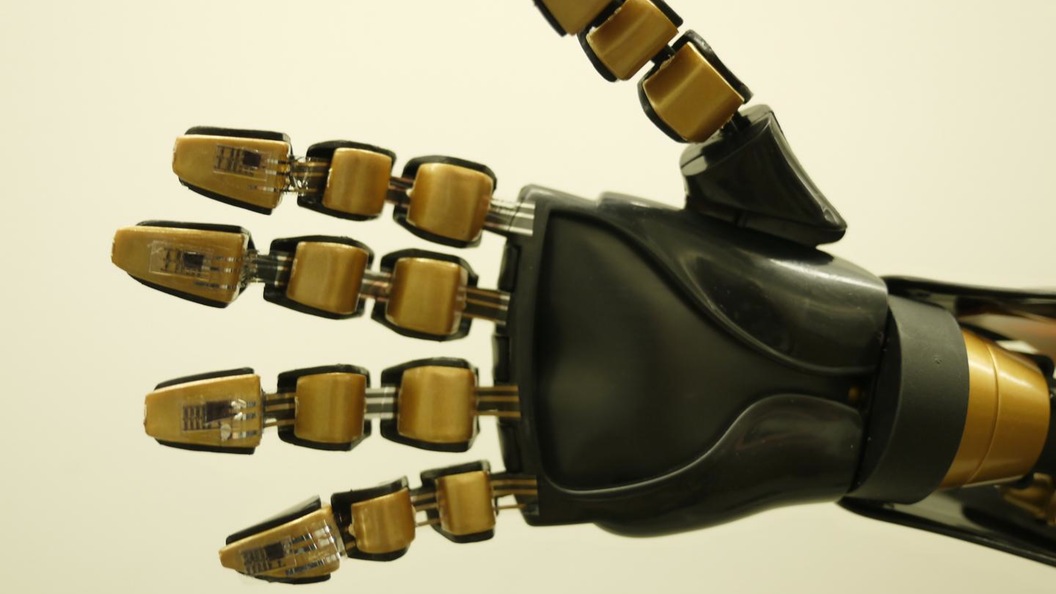
Our sense of touch is made possible thanks to thousands of “mechanoreceptors,” which are distributed throughout our skin. The more pressure that’s applied to one of these sensors, the more electrical pulses it sends to the brain, thus increasing the tactile sensation that we experience. Led by Prof. Zhenan Bao, scientists at Stanford University have now created synthetic skin that containselectronic mechanoreceptors, which could give prosthetic limbs or robots a sense of touch.

The flexible plastic skin is made up of multiple layers – one of those serves as a pressure sensor, while another houses an ink jet-printed organic electrical circuit. Embedded on the sensory layer is an array of tiny rubber pyramids, each one filled with electrically-conductive carbon nanotubes. When pressure is applied to the skin, those pyramids compress, causing the nanotubes within them to move closer together.
via Gizmag

Continue reading 

Image: Bao Research Group, Stanford University

Leave a Reply

featured blogs
Apr 2, 2026
Build, code, and explore with your own AI-powered Mars rover kit, inspired by NASA's Perseverance mission....

featured paper

Quickly and accurately identify inter-domain leakage issues in IC designs

Sponsored by Siemens Digital Industries Software

Power domain leakage is a major IC reliability issue, often missed by traditional tools. This white paper describes challenges of identifying leakage, types of false results, and presents Siemens EDA’s Insight Analyzer. The tool proactively finds true leakage paths, filters out false positives, and helps circuit designers quickly fix risks—enabling more robust, reliable chip designs. With detailed, context-aware analysis, designers save time and improve silicon quality.

Click to read more

featured chalk talk

Connecting the World Through Space
Sponsored by Mouser Electronics and Qorvo
In this episode of Chalk Talk, Ryan Jennings from Qorvo and Amelia Dalton explore the critical components and design challenges inherent in LEO satellite infrastructure and how Qorvo’s solutions are enabling the next generation of space-based connectivity. 
Mar 30, 2026
22,782 views