fresh bytes
Subscribe Now

Damselfish can recognize each other’s faces using UV vision

damselfish_2.jpg

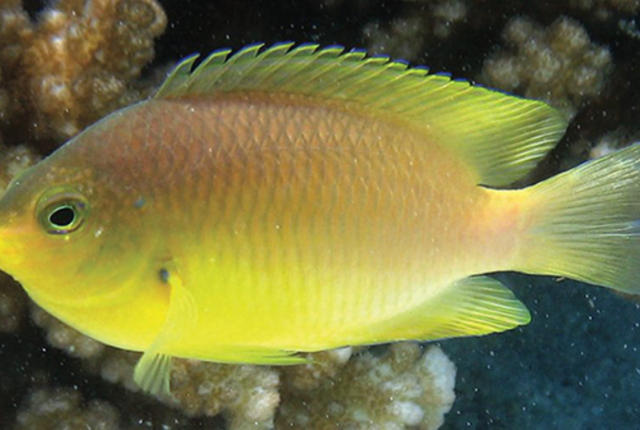
Recently presented at an academic conference in Australia, the research, led by marine scientist Ulrike Siebeck, builds on Siebeck’s own prior investigation into the damselfish’s ability to recognize the shape of ultraviolet patterns that distinguish one fish species from another. A 2010 experiment found that the damselfish relied on its ultraviolet (UV) sight to determine which particular species of fish was intruding on its territory, and thereby whether or not that particular fish’s presence necessitated an attack. When the damselfish were prevented from recognizing the intruding fish’s UV facial pattern, they were effectively blinded, unable to identify their preferred prey.

This new study finds that the damselfish is capable of even more nuanced facial recognition than previously thought, involving not just making distinctions between different species, but between individual fish as well. Captive damselfish were trained to recognize a given UV facial pattern, reinforced by a food reward. When presented with the familiar face and a strange new face, the Ambon damselfish were able to identify the correct fish face with 75 percent accuracy, a pattern that held true even when the faces were those of a similar but different species, the lemon damselfish.
via Mental Floss

Continue reading 

Image: GAGLIANO VIA WIKIMEDIA COMMONS 

Leave a Reply

featured blogs
Apr 2, 2026
Build, code, and explore with your own AI-powered Mars rover kit, inspired by NASA's Perseverance mission....

featured paper

Quickly and accurately identify inter-domain leakage issues in IC designs

Sponsored by Siemens Digital Industries Software

Power domain leakage is a major IC reliability issue, often missed by traditional tools. This white paper describes challenges of identifying leakage, types of false results, and presents Siemens EDA’s Insight Analyzer. The tool proactively finds true leakage paths, filters out false positives, and helps circuit designers quickly fix risks—enabling more robust, reliable chip designs. With detailed, context-aware analysis, designers save time and improve silicon quality.

Click to read more

featured chalk talk

GaN for Humanoid Robots
Sponsored by Mouser Electronics and Infineon
In this episode of Chalk Talk, Eric Persson and Amelia Dalton explore why power is the key driver for efficient and reliable robot movements and how GaN technologies can help motor control solutions be more compact, integrated and efficient. They also investigate the role of field-oriented control in humanoid robotic applications and why the choice of a GaN power transistor can make all the difference in your next humanoid robot project!
Apr 20, 2026
691 views